
News Center

We share the latest company news and product information from MagnetGlobal, including industry trends and business activities, selection guides and comparative tests for magnetic separators, and will update this information regularly.
china rare-earth leverage debate

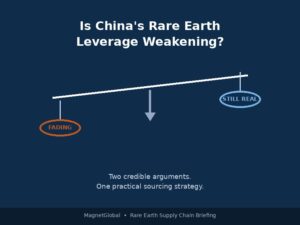
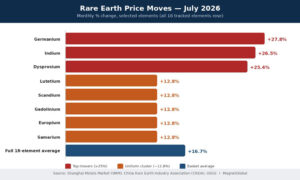
Is China’s Rare Earth Leverage Actually Weakening?

What It Means for How You Source Magnets For the past year, every rare earth headline has pointed in the same direction: China tightens, the world scrambles, prices move, buyers absorb the shock. But a growing thread of commentary is now asking a genuinely different question — does repeatedly using this leverage actually make it weaker over time? If every

Read More »
us rare-earth supply gap

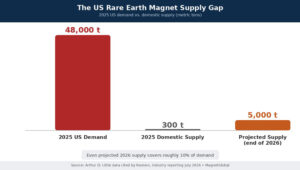
US Rare Earth Magnet Deadline 2027: Why It Affects More Than Defense

Most industrial buyers of magnetic separation equipment have no reason to read defense procurement regulations. But there’s a rule taking effect in exactly five months that’s worth five minutes of attention anyway, because the reasoning behind it is about to reshape who can access “clean” rare earth magnet supply — and that reshaping won’t stay confined to defense contracts. The

Read More »
Rare Earth Export Suspension

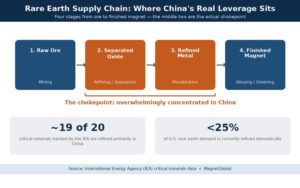
China’s Rare Earth Export Suspension Ends November 2026: What Magnetic Separator Buyers Should Do Now

There’s a deadline sitting on the calendar that most industrial buyers haven’t priced into their sourcing plans yet: China’s suspension of its expanded rare earth export controls runs out on November 10, 2026 — a little over three months from now. Unlike the sudden shutdowns and emergency scrambles that made headlines in 2025, this one comes with advance notice. The

Read More »
blog main image drawer separator | MagnetGlobal

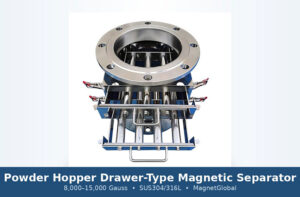
How to Choose the Right Powder Hopper Drawer Magnetic Separator

Powder Hopper Drawer-Type Magnetic Separators – The Complete Selection Guide Gravity-fed powder lines have a contamination problem that conveyor-style separators were never built to solve. Flour dust, resin pellets, ceramic glaze powder, spice blends, and fine chemical intermediates all move through hoppers and chutes under their own weight, often at low velocity and in confined ductwork where a full-size overband

Read More »
Featured Image: MagnetGlobal In-Line Liquid Magnetic Traps - High-Purity Engineering

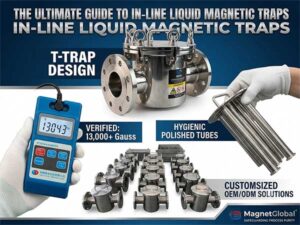
The Ultimate Guide to In-Line Liquid Magnetic Traps: Safeguarding Process Purity & Pipeline Equipment

In modern liquid processing—whether you are handling food syrups, dairy, pharmaceutical slurries, or lithium-ion battery materials—sub-micron iron contaminants are a silent, highly destructive threat. While traditional conveyor-style metal detectors are excellent for packaged goods, they often miss the microscopic, paramagnetic wear particles suspended in fast-flowing liquid lines. An in-line liquid magnetic trap (also widely recognized as a magnetic liquid filter,

Read More »
N35 vs. N52 Neodymium Rod Magnets for Industrial Use

N35 vs. N52 Neodymium Rod Magnets for Industrial Use: Breaking Down the Magnetic Grade Myth in Separation Systems

Introduction When procurement managers and plant engineers specify heavy-duty permanent magnetic separation equipment, they often head straight for the highest numbers available. It’s a common assumption during bulk material purification planning: “If I want maximum iron removal efficiency, I must force my supplier to use N52 grade rare-earth cores, right?” The short answer is: Not necessarily. While N52 is commercially

Read More »
pull vs gauss testing

Pull Testing vs. Digital Gauss Testing: Why Your Magnetic Separator Validation Needs an Upgrade for HACCP Compliance

Introduction Maintaining product safety and purity is a daily challenge for quality control and engineers in the food, pharmaceutical, and chemical industries. Magnetic separators are the first line of defense against contamination from materials such as metals. However, a key question remains: how can we accurately verify that magnetic bars still meet high standards? For decades, traditional tensile testing has

Read More »
how often should test your magnetic rods

How Often Should You Test Your Magnetic Rods? A Guide to Gauss Demagnetization & Lifetime Maintenance

In modern industrial processing, ensuring ultimate product purity is a continuous battle against metallic contamination. Whether you are running a high-capacity lithium-battery cathode material line, a strict food processing plant, or a chemical bulk handling facility, high-intensity permanent magnetic rods—such as Neodymium (NdFeB) bars—are your primary line of defense. However, a dangerous misconception exists within engineering teams: that the magnetic

Read More »
A beginner's guide to choosing the right magnetic rod shape

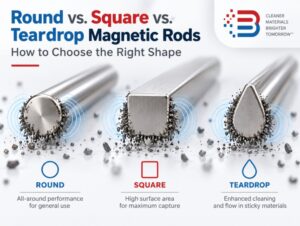
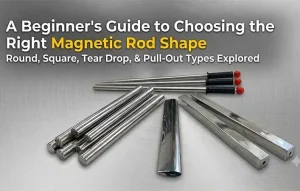
How to Choose the Right Magnetic Rod Shape for Industrial Iron Removal: Round, Square, Tear Drop, or Pull-Out?

In modern B2B industrial manufacturing—whether processing food ingredients, fine chemicals, pharmaceuticals, or high-purity lithium battery materials—ferromagnetic contamination is a silent profit killer. Even microscopic iron particles can lead to catastrophic product defects, costly batch rejections, and severe wear on expensive downstream machinery. To safeguard production lines, magnetic filter rods (also known as magnetic tubes or bars) serve as the ultimate

Read More »
Technical Guide to In Line Liquid Magnetic Traps

Complete Technical Guide to In-Line Liquid Magnetic Traps: Maximizing Fluid Process Purity and Equipment Protection

Keeping fluid production lines clean while protecting expensive downstream gear is a non-stop headache for plant engineers. Think about it: a tiny piece of rust scale from an old carbon steel pipe or microscopic wear iron from a pump can easily ruin an entire batch of product. Worse, it can destroy your high-pressure pumps, homogenizers, or filling nozzles in a

Read More »
Guide to Easy Clean Pull Out Magnetic Rod

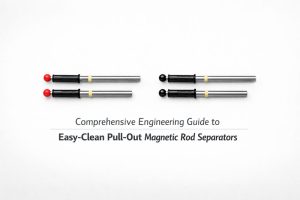
Comprehensive Engineering Guide to Easy-Clean Pull-Out Magnetic Rod Separators

In continuous bulk-handling processing lines, standard fixed magnetic grates pose a significant operational bottleneck: maintenance downtime. While traditional magnetic grids are highly efficient at intercepting hazardous ferrous particles, operators must manually wipe down every single rod to clear the captured debris. This requires halting the product stream, opening the housing, and scraping away highly abrasive fines—a process that introduces plant

Read More »
Specifying Industrial Magnetic Plate Separators

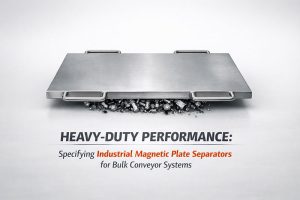
Heavy-Duty Performance: Specifying Industrial Magnetic Plate Separators for Bulk Conveyor Systems

In processing environments characterized by high material volumes, large particle sizes, and fast-moving conveyors, traditional grid or rod magnets are often impractical. When large aggregates, coal, grains, minerals, or recycled shredded tires travel at high speeds down a conveyor belt, inserting fine bars into the stream would cause material blockages, extreme mechanical abrasion, and premature grid failure. For these demanding,

Read More »
Food Grade Magnetic Grids

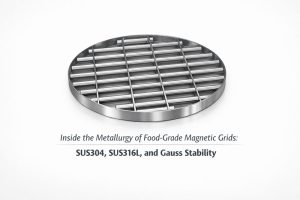
Inside the Metallurgy of Food-Grade Magnetic Grids: SUS304, SUS316L, and Gauss Stability

For quality assurance managers and compliance auditors in the food, beverage, and pharmaceutical sectors, a piece of process equipment is only as good as its sanitary certification. When a magnetic grid is placed directly into a product stream, it must not only capture ferrous contaminants but must also guarantee that it will not introduce bacterial risks, rust, or chemical impurities

Read More »
Purity Using Round Magnetic Grate

How to Optimize Material Flow and Purity Using Round Magnetic Grate Separators

In modern dry bulk handling and powder processing, safeguarding production lines from microscopic metal fragments is a dual challenge of ensuring product purity and preventing catastrophic machinery damage. For processing lines utilizing vertical gravity chutes, circular hoppers, and pneumatic pipelines, the Food Grade Round Magnetic Grate stands as the most reliable, passive defense mechanism available. However, simply placing a generic

Read More »
Food Grade Magnetic Bars

Understanding Sanitary Standards for Food Grade Magnetic Bars in Material Purification

The Crucial Role of Sanitary Defeathering Systems In hygiene-sensitive processing sectors such as industrial food engineering, infant formula production, and pharmaceuticals, avoiding batch contamination is a matter of strict international regulatory compliance. Plant engineers in these fields rely heavily on high-intensity Tube Magnets to eliminate fine mechanical iron flakes and rust particles from raw ingredients. However, using a standard industrial

Read More »
Select the Gauss Rating for Industrial Magnetic Filter Rods

How to Correctly Measure and Select the Gauss Rating for Industrial Magnetic Filter Rods

Why Surface Gauss Matters in Industrial Separation When procurement managers and plant engineers source industrial separation components, the surface magnetic intensity, commonly measured in Gauss, stands as the most critical technical specification. However, a widespread challenge in the B2B sector is the misunderstanding of how these Gauss ratings are measured and how to select the optimal strength for specific production

Read More »
what is a magnetic rod

What is a neodymium magnetic rod and what is its purpose?

What is a Neodymium Magnetic Rod? A neodymium magnetic rod is a cylindrical, high-strength permanent magnet assembly typically made from neodymium iron boron (NdFeB) rare earth material or high-coercivity ferrite. Often referred to in processing sectors as high-flux Magnetic Bars or industrial Tube Magnets, it features an outer protective layer of 304 or 316 stainless steel, with flanged ends or

Read More »

Contact Us

If you have any needs or questions, please feel free to contact us. Our team is always available — real people, ready to help at every step.
contact-us
Contact Form EN
Scroll to Top