Introduction
When procurement managers and plant engineers specify heavy-duty permanent magnetic separation equipment, they often head straight for the highest numbers available. It’s a common assumption during bulk material purification planning: “If I want maximum iron removal efficiency, I must force my supplier to use N52 grade rare-earth cores, right?”
The short answer is: Not necessarily. While N52 is commercially celebrated as one of the most powerful industrial magnet options on the market—exerting pull forces several times its own weight—using it blindly in harsh, hygiene-sensitive industrial environments can lead to premature demagnetization, unexpected brittle breakage, and wasted engineering budget.
To help you secure strict quality control across your production lines, let’s break down the precise metallurgy, physical differences, and thermal limitations between N35 and N52 grades within industrial neodymium rod filter tube magnets.
The Physics Behind the Grades: N35 vs. N52
In rare-earth metallurgy (Nd2Fe14B tetragonal crystal structures), the “N” rating dictates the magnet’s Maximum Energy Product, known as (BH)max, measured in Mega Gauss-Oersteds (MGOe).
When we convert MGOe to the standard international SI unit (1 MGOe = 8 kA/m³), the performance gap becomes scientifically clear:
-
- Grade N35: Features an intrinsic maximum energy product of 33 to 36 MGOe, delivering approximately 270 kA/m³.
- Grade N52: Represents a much higher performance tier, holding a maximum magnetic energy product of 48 to 51 MGOe, delivering up to 400 kA/m³.
The Raw Gauss vs. Engineered Circuit Reality
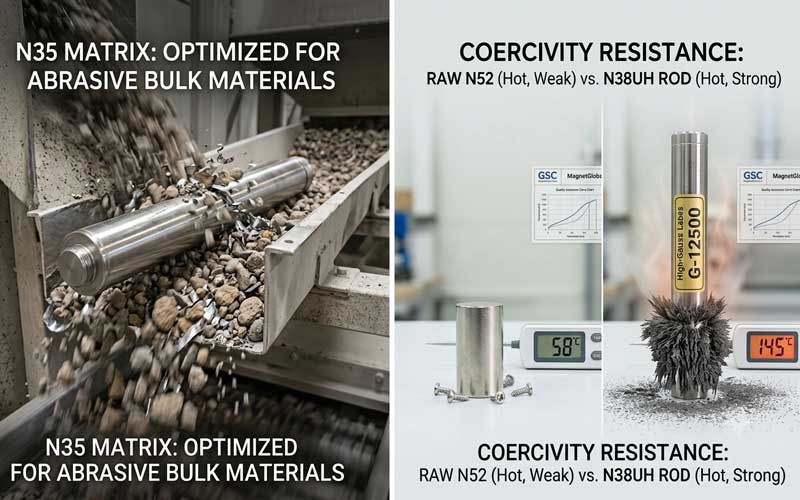
For a standard, standalone cylindrical rod piece of raw magnet at room temperature, a grade N35 magnet typically generates a raw surface magnetic field strength of around 11,700 Gauss. In contrast, a raw N52 magnet can reach up to 14,500 Gauss.
However, a professional industrial magnetic filter rod is never just a raw piece of magnet. It is an optimized magnetic circuit encased in a heavy-duty, seamless SUS304 or SUS316L stainless steel tube. By precision-stacking cylindrical elements with high-permeability magnetic flux guiding plates, specialized manufacturers can compress the magnetic field, engineering a local surface strength that reaches 12,000 to 15,000 Gauss even when using robust, balanced sub-N52 core matrices.
The Temperature Paradox: Why N52 Might Fail Your Line
The most critical factor hidden in supplier datasheets is thermal stability. Many procurement managers are shocked to discover that higher-grade neodymium magnets can actually be more sensitive to heat than lower-grade options.
According to official NdFeB metallurgical data, standard N50 and N52 grades actually have a lower maximum working temperature limit (only 70°C) compared to N35-N48 grades (which withstand 80°C). Furthermore, their intrinsic coercivity (Hcj) drops significantly to 875 kA/m or lower.
For facilities seeking thermal durability, specifying a grade like 48M offers a powerful compromise—delivering a high energy product of 48 MGOe while safely raising the thermal threshold to 100°C with a much stronger resistance to demagnetization (greater than or equal to 1114 kA/m).
Table 1: Standard N-Series Physical Properties (N35 to N52)
Note the trade-off in maximum working temperature as magnetic strength peaks:
| Grade | Remanence Flux Density (Br) | Coercivity Force (Hcb) | Intrinsic Coercivity (Hcj) | Max Energy Product (BH)max | Max Work Temp |
| N35 | 1.21 T / 12.1 kGs | 907 kA/m / 11.4 kOe | >= 955 kA/m / 12 kOe | 35 MGOe / 297 kJ/m³ | 80°C |
| N42 | 1.33 T / 13.3 kGs | 979 kA/m / 12.3 kOe | >= 955 kA/m / 12 kOe | 42 MGOe / 342 kJ/m³ | 80°C |
| N45 | 1.36 T / 13.6 kGs | 963 kA/m / 12.1 kOe | >= 955 kA/m / 12 kOe | 45 MGOe / 358 kJ/m³ | 80°C |
| N48 | 1.40 T / 14.0 kGs | 963 kA/m / 12.1 kOe | >= 955 kA/m / 12 kOe | 48 MGOe / 362 kJ/m³ | 80°C |
| N50 | 1.42 T / 14.2 kGs | 836 kA/m / 10.5 kOe | >= 875 kA/m / 11 kOe | 49 MGOe / 390 kJ/m³ | 70°C |
| N52 | 1.44 T / 14.4 kGs | 836 kA/m / 10.5 kOe | >= 875 kA/m / 11 kOe | 51 MGOe / 406 kJ/m³ | 70°C |
Table 2: High-Coercivity M-Series Physical Properties (Up to 100°C)
When your pipelines undergo high-temperature processing or automated Clean-in-Place (CIP) washdowns, the M-series provides superior resistance to demagnetization:
| Grade | Remanence Flux Density (Br) | Coercivity Force (Hcb) | Intrinsic Coercivity (Hcj) | Max Energy Product (BH)max | Max Work Temp |
| 38M | 1.26 T / 12.6 kGs | 971 kA/m / 12.2 kOe | >= 1114 kA/m / 14 kOe | 38 MGOe / 302 kJ/m³ | 100°C |
| 42M | 1.33 T / 13.3 kGs | 987 kA/m / 12.4 kOe | >= 1114 kA/m / 14 kOe | 42 MGOe / 334 kJ/m³ | 100°C |
| 45M | 1.36 T / 13.6 kGs | 963 kA/m / 12.1 kOe | >= 1114 kA/m / 14 kOe | 45 MGOe / 358 kJ/m³ | 100°C |
| 48M | 1.39 T / 13.9 kGs | 1027 kA/m / 12.9 kOe | >= 1114 kA/m / 14 kOe | 48 MGOe / 382 kJ/m³ | 100°C |
| 50M | 1.42 T / 14.2 kGs | 1035 kA/m / 13.0 kOe | >= 1035 kA/m / 13 kOe | 49 MGOe / 390 kJ/m³ | 90°C |
Note: For extreme thermal environments exceeding 100°C, custom configurations utilize specialized SH, UH, EH, or AH permanent tube magnets rated up to 350°C.
Durability & Mechanical Stress: Brittle Fracture Risks
Industrial separation systems are constantly subjected to severe mechanical stress, gravitational drops, and abrasive material flows. This brings another major physical difference to light: Durability vs. Power.
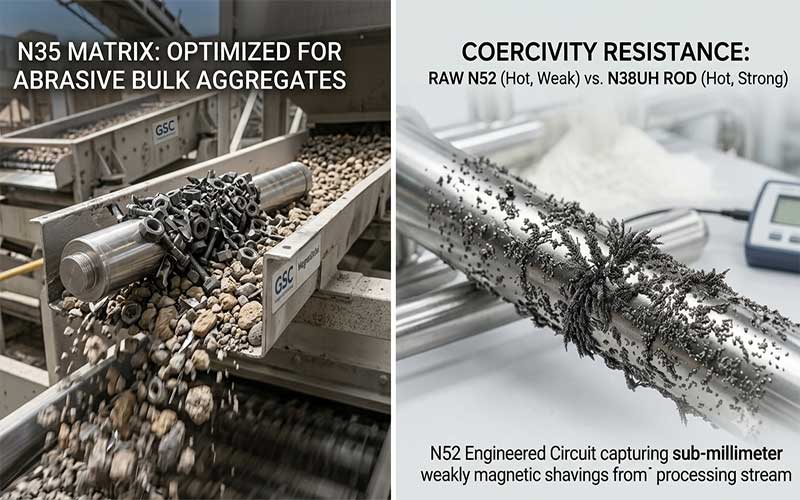
Because N52 magnets require a highly precise manufacturing process and a denser concentration of elemental neodymium, they are inherently more brittle and prone to chipping or breaking under physical impact compared to N35 magnets.
If your material chutes handle heavy bulk aggregates or abrasive granules, a micro-fracture inside the rod can cause internal magnetic circuit misalignment. An N35, N42, or N45 magnet offers a less brittle chemical structure that can better withstand repeated mechanical stress, providing a longer service life with minimal maintenance.
Blueprint Checklist: Making the Right B2B Selection
To balance cost-efficiency with high-purity extraction performance, use this engineering logic for your next RFQ:
- Space Constraints & Peak Extraction: If your automated processing line has strict dimensional space limitations but demands the absolute maximum extraction of microscopic iron dust or sub-millimeter weakly magnetic stainless steel shavings, an engineered, coated N52 circuit running at room temperature is the ideal choice.
- Standard Food/Pharma Audits: For gravity-fed hoppers and vertical chutes seeking HACCP or FDA compliance at standard temperatures, custom-configured N45 to N50 magnetic filter bars wrapped in mirror-polished SUS316L provide the perfect price-to-performance ratio without the high premium of N52.
- High-Temperature Outlets: If your operating temperatures exceed 80°C, completely scratch standard N52 from your engineering blueprints. Request high-coercivity, heat-resistant permanent tube magnets optimized for your exact thermal processing limits.
Conclusion
Achieving continuous passive physical separation and strict contamination control requires looking beyond raw magnet grades. True compliance relies on a balanced synchronization of magnetic chemistry, optimized circuit engineering, and robust casing protection.
As a technically-driven, verified direct manufacturer, MagnetGlobal provides full transparency—including demagnetization curve charts and digital Gauss mapping—before delivery. Contact our engineering team today to receive professional, reliable advice and tailored factory-direct pricing for your custom pipeline configurations.