The US Just Backed $4.3 Billion in Rare Earth Deals in Five Weeks
What the Funding Pace Actually Changes
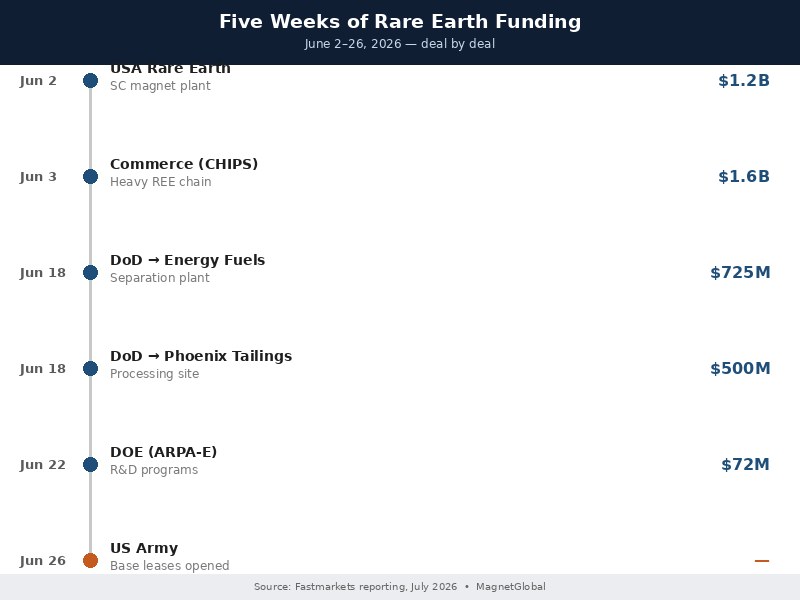
Money moved into the Western rare earth supply chain faster this summer than at any point we’ve covered so far. Between June 2 and June 26, 2026, the US government committed close to $2.9 billion in direct federal funding to rebuild a rare earth metals and permanent magnet supply chain outside China, and companies receiving that support layered on a further $1.4 billion of their own capital — seven deals, four federal channels, over $4.3 billion combined, all disclosed within a single month.
That concentration is worth understanding on its own terms, separate from any individual project we’ve mentioned in past articles. The question isn’t whether this is happening — the paper trail is clear — but what a funding wave this fast actually changes about the timeline buyers should be planning around, and what it doesn’t.
The Deal-by-Deal Breakdown
| Date | Channel | Amount | Purpose |
| Jun 2 | USA Rare Earth (self-funded + partners) | $1.2B, plus up to $204M for French subsidiary | New NdFeB magnet and refined metals facility in Cherokee County, South Carolina — targeting 6,400 t/yr magnets and 5,000 t/yr strip-cast metal/alloy |
| Jun 3 | Commerce Dept. (CHIPS Act) | Up to $1.6B ($277M direct + $1.3B loan capacity) | Heavy rare earth mining, metal, and magnet chain, including Round Top, Texas deposit, targeted for 2028 |
| Jun 18 | DoD Office of Strategic Capital | $725M | Loan to Energy Fuels for a rare earth separation and metallization facility |
| Jun 18 | DoD Office of Strategic Capital | $500M | Loan to Phoenix Tailings for its “Freedom Facility” (total ~$1B with private capital) |
| Jun 22 | DOE (ARPA-E) | $72M | Two research programs: faster mineral discovery, domestic magnet development |
Four of these five funded projects are targeting a 2028 start date — a detail worth holding onto for later in this piece.
Opening the Bases: A New Kind of Infrastructure Access
On June 26, the US Army announced it would allow four critical minerals processors to build facilities on military bases through long-term leases — the first time critical minerals processing has been permitted on federal installations at all. Among them: REalloys will build a heavy rare earth alloy and magnet facility at Tooele Army Depot in Utah, specifically to process dysprosium and terbium — the two elements most directly tied to high-temperature magnet grades. The leases execute a March 2025 executive order aimed at domestic mineral production for national security, with development possible as early as 2027 and initial operating capability targeted for 2028.
For context on how exposed the US currently is: USGS data puts the country at 67% import-dependent for rare earths overall, and fully import-reliant for natural graphite.
The International Dimension Widened Too
On June 23, the EU, Germany, the Netherlands, and Greece joined the US-led Pax Silica Forum, an initiative building resilient supply chains for the critical minerals and materials that underpin AI-relevant technologies. The forum now spans Australia, Finland, India, Israel, Japan, Norway, Qatar, South Korea, Singapore, Sweden, the Philippines, the UAE, and the UK alongside the US — a coalition explicitly organized around reducing dependence on China-linked supply chains for exactly the materials in this funding wave.
The Same Month, the Geopolitical Edge Sharpened
This funding wave didn’t happen in isolation from the trade tension we’ve covered before. On June 8, the US added 65 Chinese companies — including BYD, NIO, EVE Energy, and CALB — to its Section 1260H list, barring them from supplying the Department of Defense. China responded in kind on June 22, adding ten US entities to its own export control list, including two of the very companies at the center of this funding wave: MP Materials and USA Rare Earth. That’s the same June 22 listing action we covered in an earlier piece on this blog — worth noting because it shows the funding surge and the retaliatory listing happened in the same narrow window, not as separate, unrelated storylines.
What a Faster Funding Pace Does and Doesn’t Change
What it changes: A concentrated burst of funding like this compresses the early stages of a project — permitting, engineering, initial construction — faster than a slower, piecemeal funding environment allows. Direct military base access is a genuinely new lever that didn’t exist before June 26. And a widening international coalition changes the diplomatic backdrop suppliers and customers price risk against.
What it doesn’t change: Four of the five funded projects above are targeting 2028 — not this year, not next year. Capital committed in June doesn’t produce a single tonne of separated dysprosium or a single finished magnet any faster than the underlying engineering and construction timeline allows. As the original reporting on this funding wave put it, the real test isn’t whether the money showed up — it’s whether the capacity it’s buying actually reaches production on schedule, and whether June’s pace of announcements continues or turns out to have been a one-off cluster.
What This Means for Your Sourcing Decisions
- Don’t read funding announcements as supply announcements. A $4.3 billion, five-week funding wave is genuinely significant as a policy signal, but it’s a leading indicator for 2028 capacity, not a change to what’s available to you today.
- The Tooele, Utah heavy rare earth facility is worth watching specificallyif your applications depend on dysprosium or terbium for high-temperature magnet grades — it’s one of the few announced projects targeting heavy rare earth processing directly rather than light rare earth (NdPr) supply.
- Expect the geopolitical back-and-forth to continue in parallel with the funding buildout, not instead of it. June’s pattern — US funding wave and Chinese counter-listing landing in the same window — is a reasonable template for how this is likely to keep playing out.
Talk to MagnetGlobal About Your Supply Chain Planning
If you’re trying to figure out how a funding surge on one side and continued trade tension on the other actually affects your own sourcing timeline, reach out to our team. We track these developments closely and are happy to talk through what it means for your specific materials and applications.
This article reflects publicly available reporting as of early September 2026 and is intended as general background, not financial or procurement advice. Confirm current supply chain conditions with your supplier before making sourcing decisions.