Last month we wrote about a broad rare earth price surge – all 18 tracked elements up, average gain of nearly 17 percent, and a real case for revisiting your quote timing before your next order. If you locked in a supply agreement or rushed a purchase order based on that trend, here’s the update worth reading: August didn’t continue the climb. It reversed a big part of it.
This isn’t a “false alarm, ignore last month” piece. It’s a more useful lesson: rare earth pricing moves in both directions, often quickly, and reading a single month’s headline number without looking at what’s actually driving it can lead to the wrong decision either way – panic-buying on the way up, or assuming the pressure is gone on the way down.
What Happened in August: A Broad Pullback, But Not a Uniform One
Of the 19 rare earth elements tracked this month, 13 declined and only 6 posted gains – average change across the basket was -5.4%, with a median of -9.2%. Gallium led the declines at -18.8%. Erbium was the lone standout, posting the only double-digit gain of the month at +17.6%.
| Element | August Change |
|---|---|
| Gallium | -18.8% (largest decline) |
| Erbium | +17.6% (largest gain) |
| Basket average | -5.4% |
| Basket median | -9.2% |
| Elements declining | 13 of 19 |
| Elements rising | 6 of 19 |
Compare that to July, when every single tracked element rose together – a level of uniformity analysts flagged at the time as unusual. August’s move is broad, but it’s the opposite kind of broad: a widespread cooling rather than a widespread spike.
The Detail That Actually Matters for Magnet Buyers: NdPr Barely Moved
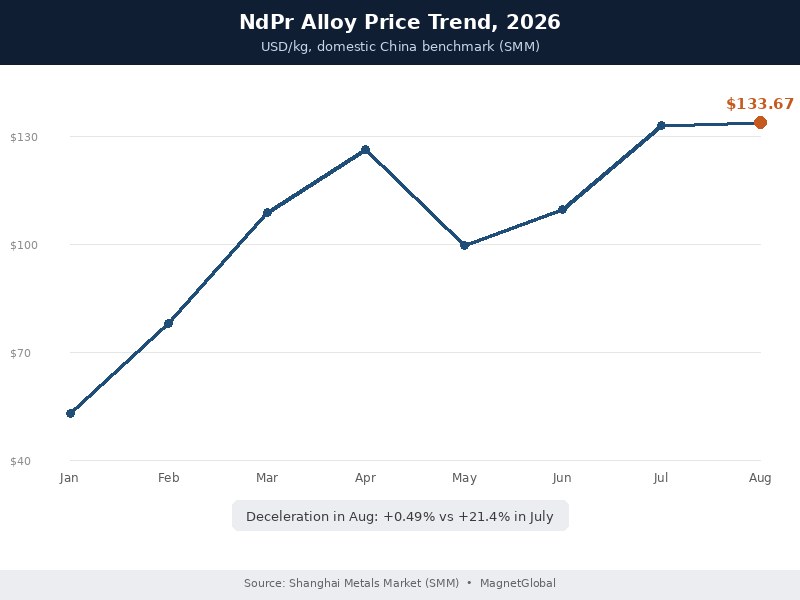
Here’s the part worth reading twice. The neodymium-praseodymium (NdPr) complex – the material complex that actually drives NdFeB magnet pricing, the kind used in magnetic separator rods and grids – didn’t decline in August at all. It kept rising, just at a much slower pace. According to Shanghai Metals Market data, the NdPr alloy benchmark (the actual procurement reference magnet makers use, as opposed to pure metal prices) reached $133.67/kg on August 3, up 0.49% from July – a sharp deceleration from June’s +10.0% and July’s +21.4% monthly moves. Praseodymium metal similarly advanced 3.46% in August, its third consecutive monthly gain, but well below July’s 19.5% jump.
Zoom out to the year-to-date picture and the pattern is clearer still: the NdPr alloy benchmark bottomed near $53/kg in January before climbing steadily through the year to today’s $133.67/kg – a move driven by what analysts describe as a structural NdPr supply deficit now in its second consecutive year, not a one-month news event. August’s slower pace of gains looks less like a reversal and more like a rally that’s stopped accelerating.
In other words, while the broader 19-element basket average makes for a dramatic-sounding headline in either direction, the specific material complex that determines what you actually pay for a magnetic rod or grid didn’t swing nearly as hard in July’s rally or August’s pullback. Elements like gallium and erbium – this month’s biggest movers – are used in semiconductors, specialty optics, and other applications largely unrelated to permanent magnet production.
This is the single most useful takeaway from two months of headline-grabbing average changes: the basket-wide number and the number that actually matters for your NdFeB quote are not the same number.
A View From the China Domestic Market
Domestic Chinese trading data tells a consistent story from a different angle. According to the Baotou Rare Earth Products Exchange, late-July domestic prices for praseodymium-neodymium oxide and metal ticked up only slightly (average PrNd oxide rose roughly 0.3 thousand RMB/tonne on the day), while heavy rare earth benchmarks – dysprosium oxide and terbium oxide, the materials used in high-temperature magnet grades – actually edged lower. Exchange commentary attributed the softness to weaker-than-expected end demand, with magnet makers buying only what they immediately need at low prices and trading houses growing more willing to sell into that softness. Sentiment surveys on the exchange leaned heavily toward “flat” for the following week (roughly 68% of respondents), with bearish sentiment actually declining – a market described as waiting for a clearer signal in trading volume rather than making a decisive move in either direction.
That lines up with the international USD-denominated data: light rare earths (NdPr) holding firm to slightly higher, heavy rare earths (Dy/Tb) softening, and the overall mood best described as cautious and range-bound rather than trending hard either way.
Why This Happened
A few forces are working against each other rather than pointing in one direction:
Easing factors: Some of July’s rally reflected positioning ahead of the November 10, 2026 expiration of China’s suspended export controls – as that date approaches without new escalation, some of that anticipatory pressure has relaxed. A regulatory gap in Indonesia that had stranded rare-earth-bearing cargo at port was also resolved on August 3, releasing supply that had been stuck in transit.
Continuing pressure factors: None of the structural dynamics we’ve covered in past articles have gone away. China’s dominance of midstream separation and refining capacity is unchanged. The January 1, 2027 U.S. defense procurement deadline is still on the calendar, and new project announcements this month – a $150 million loan for a rare-earth-free magnet plant in Minnesota, a new U.S. metal-production partnership in Wyoming, a heavy rare earth expansion in Utah – are all still years from meaningfully closing the supply gap, not weeks.
The result is a market pulling in two directions at once, which is a reasonable explanation for why the move was broad but not extreme, and why the specific NdPr complex barely participated in either direction.
What This Means for Your Sourcing Decisions
- Don’t over-correct in either direction. July’s spike didn’t justify panic-buying, and August’s pullback doesn’t mean pricing pressure is resolved. The underlying supply chain dynamics we’ve covered all year are still in place.
- Track the NdPr complex specifically, not just the headline basket average – and note that light and heavy rare earths are moving differently right now. If you’re sourcing standard-grade NdFeB magnetic rods or grids, the NdPr alloy price is your relevant benchmark, and it’s held firm. If your application needs a high-temperature grade relying on dysprosium or terbium, domestic Chinese data suggests those heavy rare earth benchmarks have actually softened slightly in recent weeks – worth asking your supplier about directly rather than assuming every grade moves together.
- Use this as a reminder to revisit quote validity windows regularly, not just when a headline catches your attention. A supplier relationship with an open, ongoing conversation about pricing trends is more useful than reacting to any single month’s number.
Talk to MagnetGlobal About Current Pricing
If you’re planning an order and want a clear read on how current NdPr pricing is actually affecting your specific magnet grade and configuration – rather than a general market headline – reach out to our team. We can walk through what’s driving your quote and help you decide whether now is a good time to lock in pricing or worth waiting on.
This article reflects publicly available market data as of late August 2026 and is intended as general background, not financial or procurement advice. Pricing conditions can change quickly; confirm current figures with your supplier before making purchasing decisions.