In modern liquid processing—whether you are handling food syrups, dairy, pharmaceutical slurries, or lithium-ion battery materials—sub-micron iron contaminants are a silent, highly destructive threat. While traditional conveyor-style metal detectors are excellent for packaged goods, they often miss the microscopic, paramagnetic wear particles suspended in fast-flowing liquid lines.
An in-line liquid magnetic trap (also widely recognized as a magnetic liquid filter, magnetic trap separator, or magnetic separator for liquid) serves as your frontline defense. These heavy-duty, stainless steel pipeline permanent magnetic separators are specifically engineered to capture microscopic iron particles, mechanical wear, and rust scale during continuous liquid processing, delivering up to 99% overall iron removal efficiency to protect both your product integrity and downstream machinery.
How Do Liquid Magnetic Traps Work? (Working Principle)
In-Line Liquid Magnetic Traps operate completely passively, requiring zero electrical energy consumption and functioning 24/7 without manual intervention.
[Raw Liquid Inlet] ---> [High-Intensity Magnetic Zone] ---> [Purified Liquid Outlet]
                                 │
                   (Ferrous particles captured on
                    underside of magnetic tubes)
-
- Direct Flow Routing: The fluid, viscous paste, or liquid slurry enters the pressure-rated housing and is directed through a concentrated, high-intensity magnetic zone.
- Maximum Contact Boundary: As the liquid flow passes through the chamber, it is forced to make close contact with multiple parallel permanent magnetic tubes arranged in a staggered configuration. This design ensures that no liquid can pass through without entering the high-gradient magnetic field.
- Magnetic Capture and Retention: Any presence of ferromagnetic impurities (such as iron filings, rust scale, and even weakly magnetic stainless steel wear particles) is instantly drawn away from the active fluid stream.
- Preventing Re-entrainment: Due to fluid dynamics, the captured metal impurities are securely retained on the undersides (downstream side) of the magnetic elements. This shielding isolates the debris from the active shear force of the liquid, ensuring that purified liquid emerges downstream while preventing any re-entrainment of captured contaminants back into the clean product line.
T-Trap vs. Other Structural Designs: Choosing the Right Layout
Different pipe configurations and fluid viscosities require specific structural designs. Here is how the most common in-line liquid magnetic trap styles compare:
1. T-Trap Magnetic Filters
- Design: The magnetic core is suspended vertically inside a T-junction pipe configuration.
- Best For: Vertical or horizontal gravity-fed lines and low-to-medium viscosity liquids.
- Advantage: Extremely compact footprint. IMI style T-Traps excel at capturing fine ferrous particles generated by everyday wear and tear in upstream pumps and mills before they can reach filling nozzles.
2. Inline Finger/Cartridge Traps
- Design: Features a larger cylindrical housing containing a multi-tube magnetic grate (finger array) that sits directly in the center of the product stream.
- Best For: High-volume, high-velocity pressurized lines.
- Advantage: Maximum surface area and contact points, ideal for high-purity applications like chocolate tempering or milk processing lines.
3. Liquid Plate Traps
- Design: Utilizes a powerful flat magnetic plate clamped to the side of a custom housing or chute.
- Best For: Liquids containing larger, abrasive debris or chunky slurries (such as soup mixtures with vegetables or fruit pulp).
- Advantage: The unobstructed flow path prevents clogging from fibrous materials while still extracting tramp iron.
Sanitary vs. Industrial Grade: Materials and Manufacturing Integrity
At MagnetGlobal, we build magnetic separators to withstand aggressive industrial environments. Understanding the difference between sanitary and industrial builds is crucial for regulatory compliance:
┌─────────────────────────────────────────────────────────────────────────┐
│                    SURFACE FINISH COMPARISON (Ra)                       │
├───────────────────────────────────┬─────────────────────────────────────┤
│      Industrial Standard          │          Sanitary Standard          │
│         (Grit Blasted)            │          (Mirror Polished)          │
│             Ra 3.0µm              │              Ra 0.4µm               │
│  [░░░░░░░░░░░░░░░░░░░░░░░░░░░░░ ] │  [─────────────────────────────────] │
│  *Suitable for powders & glazes   │  *No micro-crevices for bacteria    │
└───────────────────────────────────┴─────────────────────────────────────┘
1. Filters with Sanitary Design & Finish
Designed specifically for applications with a strict risk of bacterial growth, such as dairy, beverages, baby food, and pharmaceuticals.
- Materials: Grade SUS316L stainless steel for superior corrosion resistance against sanitizing acids and CIP chemicals.
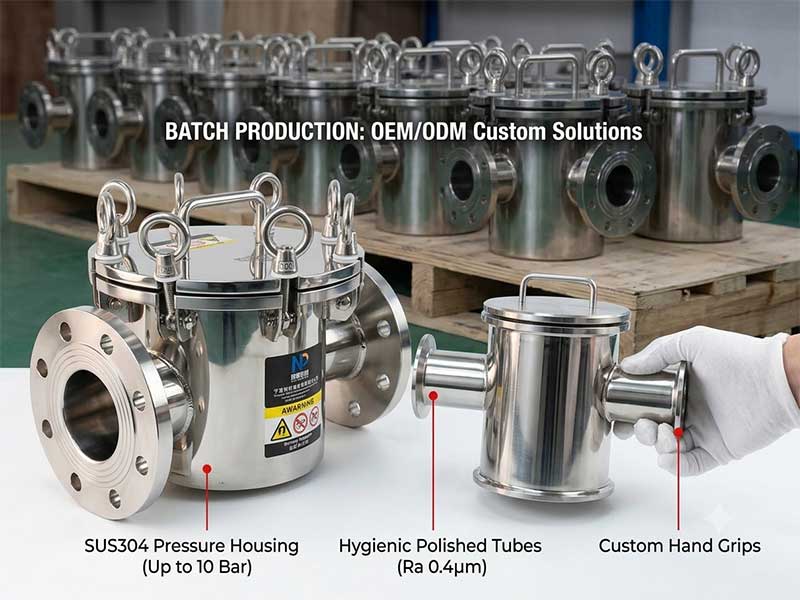
- Surface Polish: High-degree mirror polished finish down to Ra ≤ 0.4 µm. Every weld is continuous, ground smooth, and polished to satisfy strict FDA, USDA, and EHEDG sanitary standards. The rounded, sloping interior shapes leave zero micro-crevices where bacteria or stagnant product could accumulate.
- Cleaning Protocols: Fully compatible with CIP (Cleaning In Place) and SIP (Steam In Place) steam sterilization cycles.
2. Filters with Industrial Design & Finish
Designed for heavy industrial slurries, ceramics, cooling fluids, and petroleum applications where hygiene is not the primary driver, but mechanical wear resistance is.
- Materials: Standard SUS304 or SUS316 stainless steel.
- Surface Polish: Industrial grit-blasted finish with a standard Ra of approximately 3 µm.
- Applications: Highly effective for ceramic glazes (to prevent black spots during firing), pigments, lacquers, and heavy-duty machinery oil filtration.
3. Patent-Pending Radius Plate Design
Traditional tube-style liquid line magnets often suffer from tube breakage at the joint weld due to hydraulic shocking (water hammer) or heavy continuous flow.
- To address this key industry pain point, our latest engineering upgrade features a Patent-Pending Radius Plate Design.
- We apply double-welding to secure a heavy-duty radius reinforcing plate to both the magnetic tube and the housing lid. This prevents mechanical fatigue, extending the operating lifespan of the trap to several decades.
Features & Technical Specifications
| Feature | Technical Specification / Options |
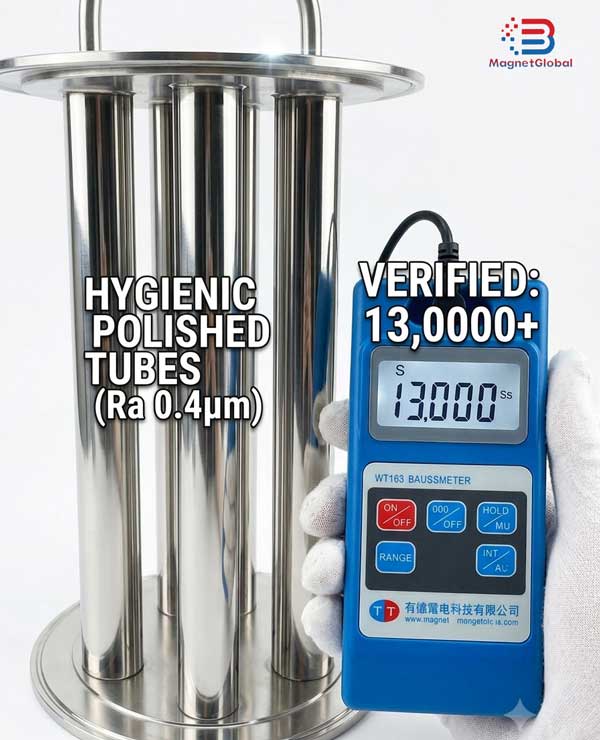
| Surface Gauss Rating | Standard 8,000 Gauss up to ultra-high 13,000 Gauss (engineered using premium NdFeB magnets with Br=14,300 Gauss) |
| Max Working Temperature | Standard configurations operate up to 80°C. Custom thermal-stabilized configurations can handle hot liquids up to 350°C (ideal for hot oil, chemical synthesis, or chocolate tempering lines) |
| Pressure Tolerance | Engineered to operate safely in pressurized liquid pipelines up to 10 bar (145 PSI) without causing significant pressure drops |
| Gasket Materials | FDA-approved, food-safe Silicone, Viton, or PTFE (Teflon) gaskets to seal against aggressive chemical solvents or high-heat food slurries |
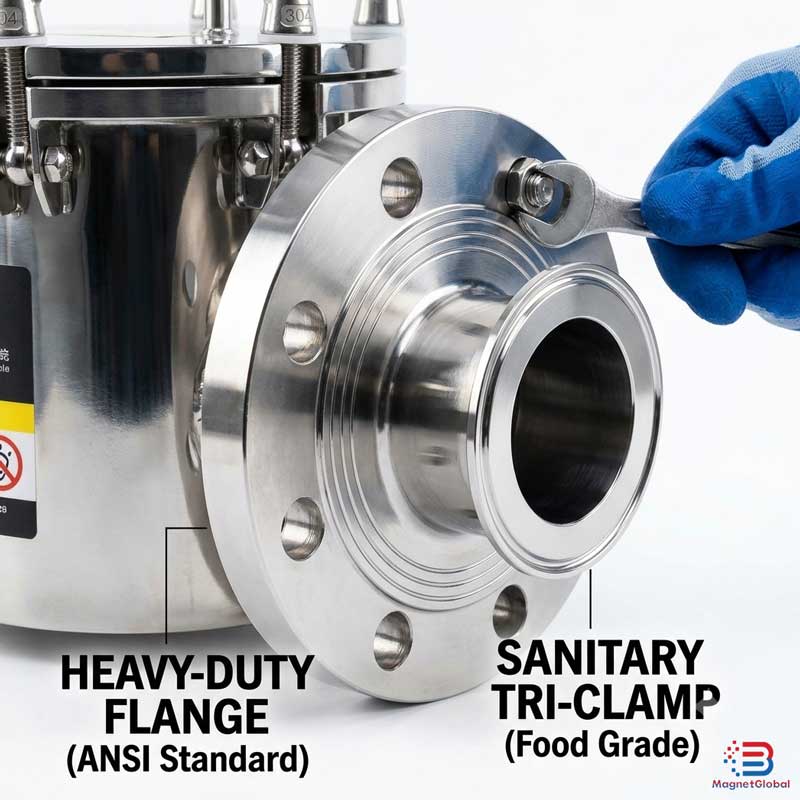
| Inlet/Outlet Connections | Sanitary Tri-Clamps (quick-release), Threaded joints (NPT/G), or heavy-duty Flanges (ANSI, DIN, JIS) |
Cleaning SOP: Manual vs. Easy-Clean Sleeve Systems
To maintain optimal separation efficiency, captured iron must be cleaned off the magnetic rods periodically. If the rods accumulate too much iron buildup, their effective magnetic field gradient decreases.
Depending on your plant’s maintenance schedule, MagnetGlobal offers two primary cleaning architectures:
   [Manual Clean System]                       [Easy-Clean Sleeve System]

     ┌──────────────┐                             ┌───────────────────────┐
     │ Magnetic Rod │                             │  O   Stainless Sleeve │
     ├──────────────┤                             ├───────────────────────┤
     │ [Captured    │ <--- Hand-wipe              │ ┌───────────────────┐ │
     │  Iron Dust]  │      (Requires force)       │ │ ░░░ Magnetic Rod  │ │ <--- Slide rod OUT
     └──────────────┘                             │ └───────────────────┘ │
                                                  └───────────────────────┘
                                                    *Iron drops off sleeve
                                                     automatically!
Option A: Manual Cleaning Systems
- The Process: The operator isolates the pipeline, opens the quick-release clamp lid, and pulls the magnetic assembly out. The operator then physically wipes the captured metal particles off the polished stainless steel tubes using a clean cloth or gloved hand.
- Best For: Lines with low concentration of iron contamination where cleaning is only required once a week or once a month.
Option B: Manual Quick-Cleaning (Easy-Clean Sleeve Design)
- The Process: The magnetic rods are housed inside outer stainless steel sleeves. When the assembly is removed from the housing, the operator pulls the inner magnetic core out of the outer sleeves. Because the magnetic force is removed from the sleeves, the captured iron particles automatically drop off instantly into a collection bin.
- Best For: High-concentration iron pipelines or lines that require daily/shift-by-shift cleaning. It minimizes cleaning time to under 60 seconds and reduces operator labor.
How to Choose the Right Magnetic Trap Part Number?
To help our technical team design and specify the perfect custom liquid magnetic trap layout for your production line, please evaluate these three critical questions:
- What are the inlet and outlet pipe dimensions and flow rate of your existing line?
- Why it matters: This helps us calculate the fluid velocity to ensure the trap is sized correctly to prevent restriction or pressure drops.
- What is the maximum working temperature of the fluid?
- Why it matters: Standard neodymium magnets lose their magnetic charge permanently if exposed to temperatures above their rating. We must specify high-temperature grades (M, H, SH, UH, or EH series) for hot lines.
- What are the physical and chemical properties of your liquid?
- Why it matters: If your slurry has high acidity, alkalinity, or is highly corrosive, we must utilize SUS316L stainless steel and chemical-resistant Viton or PTFE gaskets. If your fluid is viscous (like honey or chocolate), we may recommend a heated water-jacketed housing to keep the product flowing smoothly.
Partner with MagnetGlobal for Custom Pipeline Protection
Don’t let microscopic metal contaminants compromise your brand’s product quality, trigger expensive product recalls, or cause catastrophic wear to your high-pressure pumps and homogenizers.
[Contact MagnetGlobal’s engineering team today] for a customized proposal tailored to your pipe layout, or [explore our complete catalog of industrial magnetic separators]. As a professional, direct-factory OEM/ODM manufacturer, we provide the industrial peace of mind your process deserves.