What It Means for How You Source Magnets
For the past year, every rare earth headline has pointed in the same direction: China tightens, the world scrambles, prices move, buyers absorb the shock. But a growing thread of commentary is now asking a genuinely different question — does repeatedly using this leverage actually make it weaker over time? If every round of restrictions accelerates the rest of the world’s push toward alternative supply, substitute materials, and redesigned products, is China’s rare earth “weapon” quietly losing some of its force with each use?
This isn’t a settled question, and this piece won’t pretend it is. What follows is a look at both sides of that argument, and — more usefully — what it means for how you actually plan your magnet sourcing, regardless of which side turns out to be right.
The Case That Leverage Is Fading
The core logic here is straightforward: coercive economic tools tend to lose effectiveness with repeated use, because each use teaches the target how to route around it next time. Commentary making this case points to a genuinely different landscape than existed even two years ago — Western mining and processing capacity that didn’t exist before is now coming online, alternative sourcing arrangements are being built specifically to reduce single-country dependency, and manufacturers are actively redesigning products to use less of the specific materials China controls most tightly.
The pattern isn’t hypothetical. Over the past several months alone, the developments already covered in our previous coverage add up to something real: expanded U.S. processing capacity from producers like MP Materials and Energy Fuels, a new magnet-capacity-sharing initiative opened this month to any domestic or allied manufacturer, and continued research into magnet designs that avoid rare earth content altogether. None of these individually breaks China’s position. Collectively, they represent a market that is visibly responding rather than simply absorbing repeated shocks passively.
The Case That the Leverage Is Still Very Real
The counter-argument doesn’t dispute that these responses are happening — it disputes that they’re happening fast enough, or deeply enough, to meaningfully change the current balance of power.
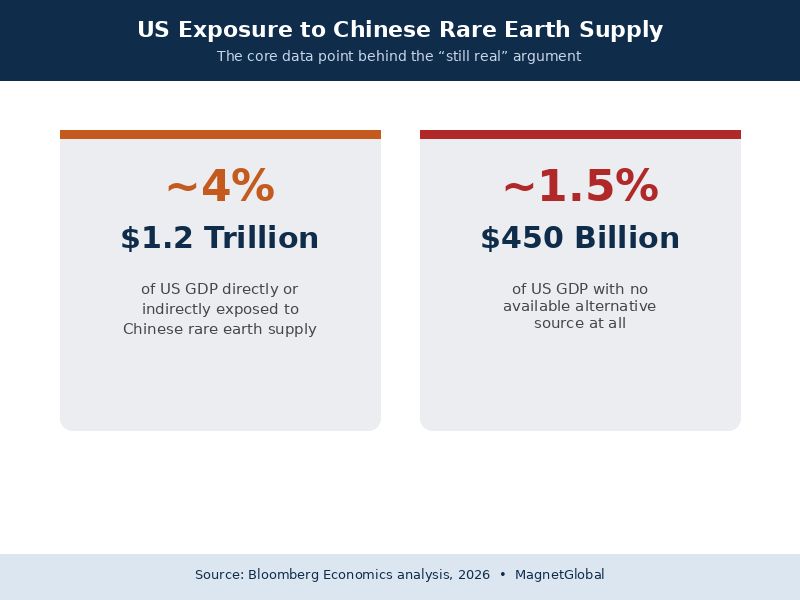
Recent analysis estimates that roughly 4% of U.S. GDP — on the order of $1.2 trillion — is directly or indirectly exposed to Chinese rare earth supply, and that about 1.5% of GDP, or roughly $450 billion, currently has no available alternative source at all. That’s not a rounding error; it’s a structural dependency that new mines and pilot processing lines don’t close quickly, regardless of how promising the headlines around them look. Reporting on this also notes that Chinese authorities are continuing to collect detailed end-use data from mineral importers — information that would make any future restriction easier to target precisely, rather than harder to enforce.
There’s also a psychological dimension worth taking seriously: the shock of last year’s restrictions is reported to have made Western policymakers measurably more cautious across a range of unrelated decisions, from defense strategy to export rulemaking, specifically because Beijing demonstrated it could reintroduce these measures quickly. A tool that changes the other side’s behavior just by existing in reserve hasn’t obviously lost its force — arguably the opposite.
Two Real Trends, Not One Correct Answer
Both of these things can be true at once, and probably are: the world is genuinely building alternatives faster than at any point in the past decade, and the underlying dependency is still large enough that a serious restriction today would still cause real disruption. The mistake would be picking one narrative and planning your sourcing entirely around it — either assuming the problem is basically solved because headlines about new capacity keep appearing, or assuming nothing has changed and treating every quote as if scarcity is permanent and absolute.
The gap between “capacity is being built” and “capacity has meaningfully closed the dependency” is measured in years, not months. Every piece of positive supply-chain news we’ve covered so far in 2026 — new processing lines, new capacity-sharing programs, new funding — comes with a timeline attached, and most of those timelines extend well past any near-term deadline currently on the table.
What This Means for How You Source
If neither the optimistic nor the pessimistic case is fully settled, the most useful response isn’t to bet heavily on either outcome. A few practical implications follow from that:
- Diversification is worth pursuing on its own merits, not as a reaction to the latest headline. A supplier relationship built during a calm period tends to be more durable than one negotiated during a scramble.
- Stockpiling as a primary strategy has real limits. It manages a short-term shock but doesn’t address a dependency that could persist for years — and ties up working capital in the process.
- Staying informed matters more than reacting to any single data point. The relevant news cycle here moves in months, not years, and a supply relationship that assumed today’s conditions were permanent six months ago is probably already out of date.
- Ask your supplier how they think about this, not just what they charge. A supplier who can speak specifically to where their materials originate and how they’re positioned for either scenario is a more durable long-term partner than one who can only quote a price.
Where MagnetGlobal Fits
We don’t have a definitive answer to which side of this debate is right, and we’re skeptical of anyone who claims they do. What we can offer is a straightforward account of where our own materials come from and how our sourcing is positioned as this situation continues to develop. If that’s useful context for your own planning, reach out to our engineering team — we’re happy to talk through it.
This article reflects publicly available commentary and analysis as of early August 2026 and is intended as general background, not financial or procurement advice. The rare earth supply situation continues to evolve; confirm current conditions with your supplier before making sourcing decisions.