If a quote for magnetic separation equipment came in higher than expected this month, or a supplier asked to requote a project that was priced only weeks earlier, there’s a straightforward explanation: July was one of the broadest rare earth price moves of the year. This isn’t a single-material spike or a one-off supply disruption — it’s a market-wide shift that touches nearly every tier of magnet pricing, from standard-grade NdFeB rods to the high-temperature grades used in demanding industrial environments.
This piece isn’t a market forecast. It’s a plain-language look at what moved, why it matters specifically for buyers of magnetic separation equipment, and what to do about it before your next quote request.
What Happened in July: Broad-Based Gains, No Exceptions
Industry price tracking shows every one of the 18 rare earth elements monitored rose in price during July 2026, with an average gain across the tracked basket of roughly 17 percent. Germanium, dysprosium, and indium led the move, each posting gains above 25 percent for the month. A cluster of five other elements — gadolinium, samarium, europium, lutetium, and scandium — each rose by almost exactly the same percentage, a level of uniformity across chemically unrelated materials that’s unusual enough to be worth noting on its own.
| Element | Approximate July Gain |
| Germanium | +27.8% |
| Dysprosium | +25.4% |
| Indium | +26.5% |
| Gadolinium, Samarium, Europium, Lutetium, Scandium | ~+12.8% each |
| Full 18-element basket (average) | +16.7% |
The breadth of the move is the actual story here, not any single element. A narrow spike in one material is common enough — a broad, simultaneous rise across an entire tracked basket, following a volatile first half of the year, is a different kind of signal about underlying market conditions.
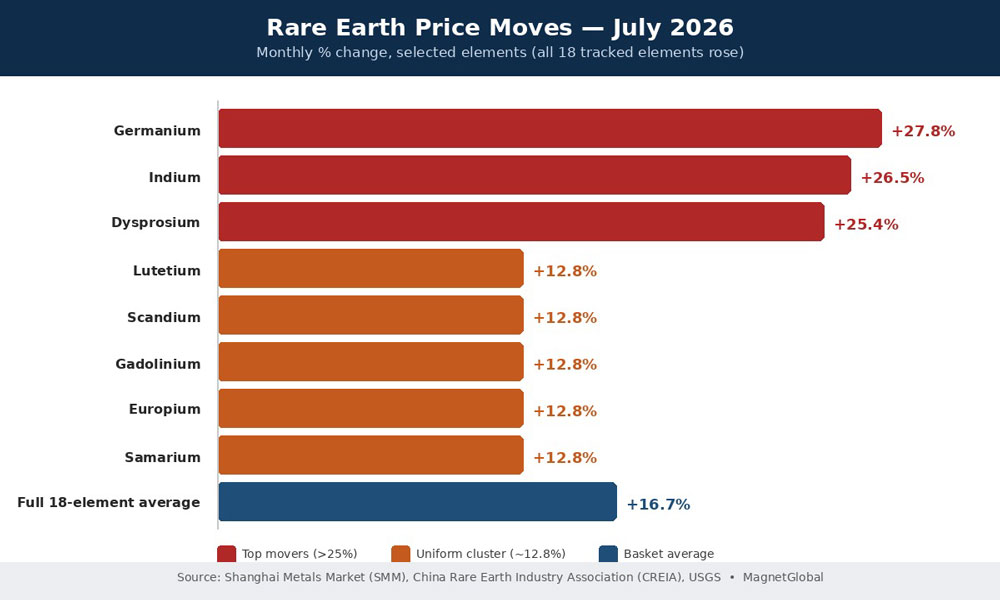
Figure: Rare earth price moves, July 2026 (source: SMM, CREIA, USGS)
Why This Matters Specifically for Magnetic Separator Buyers: Not All Magnet Grades Are Equally Exposed
The detail most worth understanding here is that dysprosium’s 25%+ jump doesn’t affect all NdFeB magnets equally. Standard-grade neodymium magnets (the N-series grades most commonly used in ambient-temperature magnetic separation equipment) contain little to no dysprosium or terbium. Higher-temperature grades — often labeled H, SH, UH, EH, or AH — rely on dysprosium and terbium additions specifically to maintain coercivity (resistance to demagnetization) at elevated operating temperatures, and are correspondingly more exposed to this month’s price move.
In practical terms: a magnetic rod or grid specified for a standard ambient-temperature powder line is largely insulated from the dysprosium spike. The same component specified for installation near a dryer, extruder, or other heat source — where a high-temperature magnet grade is genuinely required — will see meaningfully more price pressure passed through. This is the single most useful thing to check on any current or upcoming quote: is the specified magnet grade actually matched to the application’s real temperature exposure, or is it a higher grade than the application needs?
Why the Whole Basket Moved at Once
Several factors are compounding rather than any single cause. China’s suspended export controls on the broader October 2025 restrictions are approaching their November 10, 2026 expiration, and buyers across the market are adjusting positioning ahead of that date regardless of what Beijing ultimately decides. Separately, U.S. policy is pushing in its own direction: reporting this month describes a push toward eliminating rare earth magnet imports from China, Russia, Iran, and North Korea in defense supply chains by January 1, 2027 — a deadline that industry estimates suggest domestic production capacity is nowhere near ready to meet on its own. Add continued strong demand from EV and industrial motor manufacturing, and the combination is enough to move pricing broadly rather than in one isolated material.
None of this changes the practical reality for a buyer: the causes are structural and multiple, not a single event that will resolve on a predictable timeline.
What This Means for Your Next Quote
The most immediate effect isn’t the price level itself — it’s how long a quote stays valid. Suppliers are increasingly limiting quote validity windows given how quickly raw material costs are moving, and a project priced several months ago may need to be re-costed before an order is actually placed. Budget planning that assumed quote stability from earlier in the year is worth revisiting now, particularly for larger installations or multi-unit orders where the gap between quoting and purchase order can stretch to months.
Four Things to Do Before Your Next Order
- Confirm the actual temperature requirement of your application before accepting a magnet grade. If a standard N-series grade meets your real operating conditions, there’s no reason to pay the price premium attached to a high-temperature grade you don’t need.
- Ask your supplier directly how much of your quoted price is raw-material-driven versus fixed manufacturing cost. This tells you how exposed a given quote is to further movement, and which line items are worth locking in versus which aren’t.
- Check your quote’s validity window before treating it as final. If it’s shorter than it used to be, that’s a market signal worth planning around, not a sign of anything unusual about your specific supplier.
- For larger or recurring orders, ask about framework agreements or staged pricing rather than a single spot quote — spreading purchase commitments across a defined period can reduce exposure to a single volatile pricing moment.
Talk to MagnetGlobal About Your Specific Application
Every application has a different real temperature and performance requirement, and getting the magnet grade right is the most direct lever available for managing cost exposure right now. If you’re not sure whether your current specification is matched to what your process actually needs, reach out to our engineering team — we can review your application and quote against the grade that actually fits, not the one that happens to be the default.
This article reflects publicly available market data as of late July 2026 and is intended as general background, not financial or procurement advice. Pricing conditions can change quickly; confirm current figures with your supplier before making purchasing decisions.