Most industrial buyers of magnetic separation equipment have no reason to read defense procurement regulations. But there’s a rule taking effect in exactly five months that’s worth five minutes of attention anyway, because the reasoning behind it is about to reshape who can access “clean” rare earth magnet supply — and that reshaping won’t stay confined to defense contracts.
The Rule: No More Waivers After January 1, 2027
Under existing federal regulations, defense contractors and certain other federal suppliers are required to stop purchasing specified rare earths, magnets, tungsten, molybdenum, and tantalum sourced from China, Russia, Iran, or North Korea by January 1, 2027. This isn’t a new rule — Washington has restricted these purchases for years — but it has historically been softened by waivers, granted routinely because domestic and allied supply simply couldn’t meet demand.
That’s the part changing now. In a May Truth Social post, President Trump pushed back directly against the waiver system, and in late July signed an executive order making it substantially harder for defense contractors to obtain one going forward. The message to the defense industrial base is direct: the workaround that’s kept supply chains functional for years is being closed off, on a five-month clock.
The Math Problem Nobody Has Solved Yet
The reason waivers existed in the first place is straightforward: the numbers don’t currently work without them. U.S. demand for common rare earth magnets totaled roughly 48,000 metric tons in 2025. Domestic supply covered an estimated 300 tons of that — a gap large enough that even an increase to around 5,000 tons by the end of this year would still leave the vast majority of demand unaccounted for domestically.
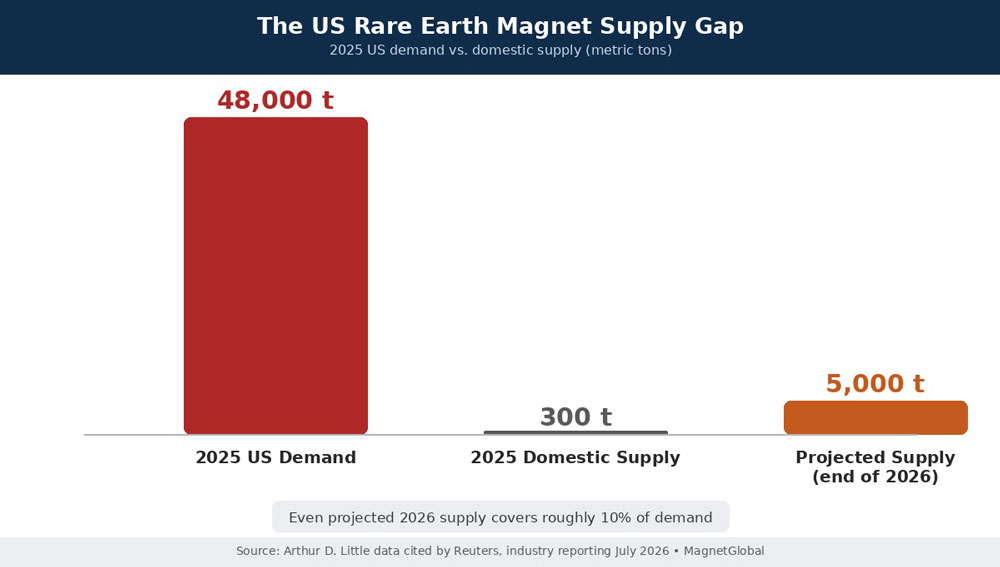
Figure: The US rare earth magnet supply gap, 2025–26 (source: Arthur D. Little / Reuters)
Money is moving to close that gap. Energy Fuels received a $725 million Pentagon loan and plans to begin processing rare earths by year-end, is acquiring an existing US magnet producer, and is targeting 6,000 metric tons of annual capacity by 2029. Ucore and ReElement have committed to supplying feedstock to magnet maker Vulcan Elements, which is building a North Carolina facility slated to open by 2030. USA Rare Earth is building a magnet plant in South Carolina. These are real, funded projects — but nearly all of them come online well after the January 2027 deadline, not before it.
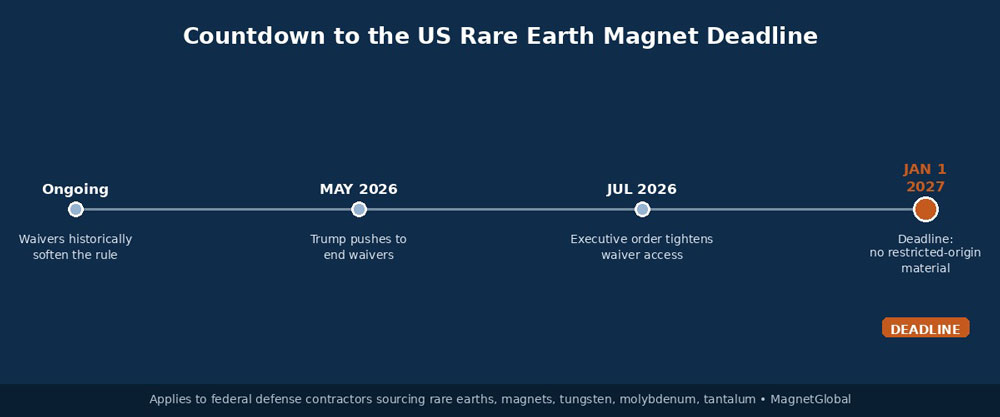
Figure: Countdown to the January 1, 2027 deadline
Why This Isn’t Just a Defense Industry Problem
It would be reasonable to read all of this and conclude it only matters if you sell to the Pentagon. That’s not quite right, for one specific reason: defense contractors and commercial buyers are drawing from the same limited pool of non-restricted-origin magnet supply.
When a rule forces a large category of buyers to source exclusively from US, allied, or otherwise verified non-China/Russia/Iran/North Korea supply chains, that demand doesn’t disappear into a separate market — it competes directly with every other buyer who was already sourcing from the same limited set of compliant suppliers, whether by choice or by their own customers’ requirements. If you supply equipment to customers who have their own compliance obligations — automotive, aerospace, or any manufacturer with defense-adjacent contracts in their own customer base — this rule can reach your supply chain indirectly even if you’ve never sold a single unit to a defense prime.
Three Ways This Plays Out
The deadline holds, and waivers genuinely tighten. Defense-adjacent demand for compliant magnet supply spikes hard in the final months of 2026, pulling supply and pushing prices across the broader compliant-origin magnet market — not just defense-designated parts.
The deadline holds on paper, but enforcement stays soft. Some industry reporting already anticipates this scenario: the rule remains in force, but practical waiver decisions continue on a case-by-case basis because the supply genuinely isn’t there yet. This reduces the shock but doesn’t remove the underlying scarcity — it just spreads it out.
The timeline slips. Given how far domestic capacity remains from meeting even a fraction of demand, a delay or phased implementation is a real possibility. This is the scenario multiple industry analysts consider most likely given the current numbers, though nothing is confirmed.
None of these scenarios point toward a return to how the supply chain worked before this policy existed. All three point toward compliant-origin documentation becoming more valuable, not less, over the next 12–18 months.
What to Ask Your Supplier Now
- Where does the raw material and processing in your magnets actually originate — not just the country of final assembly? A magnet finished outside China can still have passed through Chinese-origin processing at an earlier stage; the documentation trail matters more than the shipping label.
- Does your supplier have a plan for sourcing from non-restricted-origin material if demand for compliant supply tightens? This is worth asking even if none of your current business touches defense contracts — your customers’ compliance needs may change faster than your own.
- Is now a good time to lock in longer-term supply commitments rather than relying on spot sourcing, given that the compliant-origin portion of the market is the part under the most pressure over the next year and a half?
Where MagnetGlobal Fits
We’re not positioned to predict how enforcement plays out, and this isn’t legal or compliance guidance — check with your own trade counsel for that. But sourcing transparency is something we can help with directly: if you need clarity on where the materials in your magnetic separation equipment actually originate, or want to talk through supply contingency planning ahead of any of the scenarios above, reach out to our engineering team.
This article reflects publicly available policy reporting as of late July 2026 and is intended as general background, not legal or compliance advice. Regulatory details and enforcement timelines can change; confirm current requirements with qualified counsel before making sourcing or compliance decisions.