There’s a deadline on the calendar that most industrial buyers haven’t priced into their sourcing plans yet: China’s suspension of its expanded rare earth export controls expires on November 10, 2026 — a little over three months from now. Unlike the sudden shutdowns and emergency scrambles that made headlines in 2025, this one comes with advance notice. The question isn’t whether the policy will change again; it’s whether your supply chain is ready when it does.
This isn’t a panic piece, and it isn’t breaking news — plenty of trade publications already cover the day-to-day policy shifts in far more depth than we can. What we want to do here is translate the timeline into something more useful for anyone who specifies, buys, or maintains NdFeB-based magnetic separation equipment: a plain-language explanation of what’s actually restricted, what isn’t, and a practical checklist for the next few months.
The Timeline, in Plain Terms
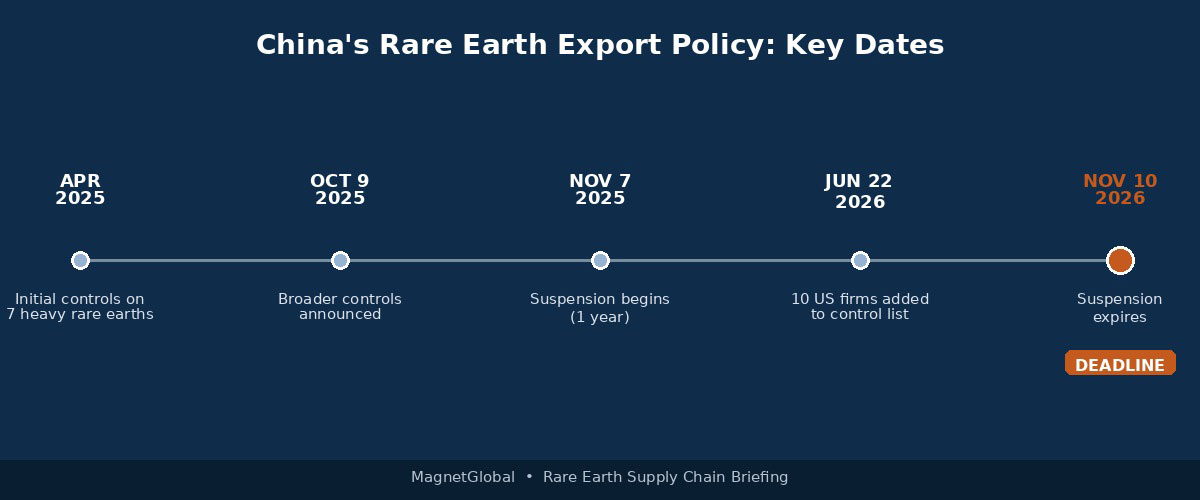
The current situation is the result of four separate developments stacked on top of each other over about eighteen months:
| Date | What Happened |
| April 2025 | China introduced export controls on seven medium and heavy rare earth elements and related compounds, metals, and magnets. |
| October 9, 2025 | Broader controls were announced (Announcements No. 61 and No. 62), extending restrictions to overseas items and technologies with even trace amounts of Chinese-origin rare earth content. |
| November 7, 2025 | As part of a broader US-China trade agreement, China suspended enforcement of the October announcements for one year, until November 10, 2026 |
| June 22, 2026 | China added ten US companies — including two of the West’s flagship rare earth producers — to its own export-control list, signaling continued willingness to act selectively even during the suspension. |
The April 2025 controls on the original seven elements remain in force today — only the newer, broader October rules are currently paused. Industry analysts tracking the policy generally expect Beijing to reassess before the suspension lapses, and the consensus view is that some form of controls will return, possibly with tighter traceability requirements rather than a simple lapse back to pre-2025 conditions.
The NdFeB Connection: Why “Neodymium Isn’t Restricted” Is Misleading
Here’s the detail that trips up many buyers: neodymium itself has never been on the restricted list. What’s controlled are specific heavy rare earths — primarily dysprosium and terbium — along with any magnet, alloy, or component that contains them, down to a threshold as low as 0.1 percent Chinese-origin content.
The practical problem is that dysprosium and terbium are exactly what get added to standard NdFeB magnets to improve their coercivity — their ability to resist demagnetization at elevated temperatures. Magnetic rods used in food, chemical, or plastics processing lines routinely operate in warm, sometimes dusty industrial environments, and many mid-to-high-grade rod formulations include small amounts of Dy or Tb for exactly that reason. A magnet can be marketed generically as “NdFeB” while still falling inside the scope of the controls once its actual composition is checked against customs declarations — which is precisely the kind of documentation mismatch that has already led to enforcement penalties for other manufacturers this year.
The Real Chokepoint Isn’t Mining — It’s What Happens in Between
It’s worth being precise about where China’s actual leverage sits, because it’s easy to assume the story is simply “China has the mines.” It isn’t, and that distinction matters for anyone trying to judge how quickly this situation could genuinely improve.
The rare earth supply chain runs through four broad stages: raw ore, separated oxide, refined metal, and finished alloy or magnet. Western investment over the past few years has concentrated heavily on the first stage (new mining projects) and the last (domestic magnet assembly). The two stages in the middle — separating mixed rare earth concentrate into individual usable elements, and converting that into pure metal — remain overwhelmingly concentrated in China. Industry estimates put China’s share of global refining capacity at roughly 19 of the 20 rare earth and critical minerals tracked by the International Energy Agency, with the United States currently able to meet less than a quarter of its own refined rare earth demand domestically.
That distinction explains why building a mine or a magnet plant outside China doesn’t, by itself, remove dependence on China. A producer can stop buying Chinese ore entirely and still need Chinese facilities — or Chinese-trained process expertise — to turn its own ore into usable separated material. For a magnetic separator buyer, the takeaway is simpler than the geopolitics: even a magnet stamped “Made outside China” may still have passed through Chinese midstream processing at some point in its production, which is exactly why origin documentation on the finished component matters more than the mine it started from.
What’s Actually Happening to Price and Lead Time Right Now
The suspension hasn’t reset the market back to pre-2025 conditions. Even with the broader October rules paused, industry pricing data through early 2026 shows continued premiums on rare earth magnet materials, particularly where buyers need assured long-term supply rather than a one-off spot purchase. Analysts covering the sector describe the current environment as one where qualification and continuity of supply — not just raw material cost — are what buyers are effectively paying for.
In short: the suspension bought the market breathing room, not a return to normal. Lead times on heavy-rare-earth-containing magnet grades remain longer and less predictable than they were before April 2025, and that’s the baseline condition buyers are working from even before accounting for what happens after November.
The Suspension Doesn’t Mean Beijing Is Standing Still
The broader October 2025 controls being on pause doesn’t mean the underlying leverage has gone quiet. On June 22, 2026, China’s Ministry of Commerce added ten American companies to its own export-control list, in what was widely read as a response to a separate US technology blacklist. Two of the named companies — MP Materials and USA Rare Earth — are the flagship projects at the center of Washington’s strategy to build a rare earth supply chain independent of China.
Both companies stated they had already stopped sourcing Chinese materials and equipment, so the immediate commercial effect was limited. The signal, though, was harder to dismiss: even while the broader suspension holds, Beijing demonstrated it can take targeted, selective action against specific companies at any point it chooses. For buyers, the practical lesson isn’t about those two companies specifically — it’s that “the controls are currently suspended” and “there is no risk of disruption before November” are not the same statement.
After November 10, 2026: Three Scenarios Worth Planning Around
Nobody can predict Beijing’s next move with certainty, but it’s worth thinking through the range of outcomes rather than assuming any single one:
Scenario A — Extension or further easing. The suspension gets renewed, or eases further as part of continued trade negotiations. This is the best case for buyers, but planning around it as the default assumption is risky.
Scenario B — Controls resume as originally announced. The October 2025 rules take effect largely as written, restoring the broader restrictions on overseas items and technologies containing trace Chinese-origin rare earth content.
Scenario C — A stricter, more targeted regime. Some industry commentary already expects this outcome specifically — a return to controls with heavier emphasis on traceability and end-use documentation rather than a simple reinstatement of the original rules.
The point of laying these out isn’t to predict which one happens. It’s that Scenarios B and C both point toward the same practical need: documentation and supplier verification matter more than they did a year ago, regardless of which way the policy ultimately breaks.
Four Things to Do Before November
- Ask your current supplier directly about raw material origin and export documentation for any NdFeB rods, plates, or grids in your existing or upcoming orders — not just a general “compliant” assurance, but the actual composition and paperwork trail.
- Audit whether your in-service or on-order equipment uses heavy-rare-earth-enhanced magnet grades, particularly for high-temperature applications where Dy/Tb additions are more likely. This matters even for equipment purchased before the controls existed, if you’re sourcing replacement rods or planning an expansion.
- Consider locking in longer-term supply agreements rather than relying on spot orders through the remainder of this year, especially for projects with installation dates that fall on either side of the November deadline.
- Ask suppliers whether a lower-heavy-rare-earth magnet specification would meet your application’s requirements. For separator applications that don’t require the highest-temperature coercivity ratings, a standard-grade NdFeB rod with minimal or no Dy/Tb content can sometimes deliver equivalent real-world capture performance without sitting anywhere near the controlled-materials line — worth a direct conversation with your engineering contact rather than assuming it’s an all-or-nothing tradeoff.
Where MagnetGlobal Fits Into Your Planning
We’re not a trade policy firm, and this isn’t a substitute for your own compliance and legal review. But as a direct manufacturer of NdFeB magnetic rods, grids, and separator equipment, supply chain planning around exactly this kind of policy timeline is part of our daily conversation with customers.
Reach out to our engineering team if you’re not sure whether your current or planned equipment involves restricted magnet grades, or you want to talk through supply timing ahead of November — we’re happy to walk through your specific material and application with you.
This article reflects publicly available policy information as of July 2026 and is intended as general background, not legal or compliance advice. Always verify current requirements with customs counsel or your compliance team before making sourcing decisions.