| Quick Summary (Key Takeaways) Magnetic separation efficiency in food, pharmaceutical, and chemical processing depends heavily on maintaining stable Gauss ratings. Over time, factors such as excessive operating temperatures, mechanical impacts, corrosive media, and poor construction quality can cause permanent demagnetization of Neodymium (NdFeB) magnetic rods. This comprehensive technical guide analyzes the root causes of magnetic flux degradation and provides practical engineering guidelines to maximize equipment lifespan and protect product purity. |
Understanding Gauss Decay: Temporary vs. Permanent Demagnetization
Industrial magnetic separators utilize high-intensity Neodymium-Iron-Boron (NdFeB) permanent magnets enclosed within stainless steel tubing (typically 304 or 316L). When plant maintenance teams measure a drop in surface Gauss rating, it is critical to distinguish between two types of magnetic loss:
- Reversible Magnetic Loss: Occurs when ferromagnetism drops temporarily due to elevated temperatures within the magnet’s rated operating limits. Once the temperature returns to ambient levels, the surface magnetic field strength recovers completely.
- Irreversible Magnetic Decay: Occurs when the magnetic domains (Weiss domains) within the sintered NdFeB lattice lose their parallel alignment due to thermal overload beyond Curie temperature limits, severe physical impact, or structural compromise. This loss cannot be recovered without factory-level re-magnetization.
Core Causes of Magnetic Strength Loss in Industrial Operation
1. Thermal Degradation & Incorrect Curie Point Selection
Standard N-grade Neodymium magnets are rated for maximum operating temperatures up to 80°C (176°F). Operating standard magnetic rods in high-temperature processing lines (e.g., hot liquid chocolate, steam-cleaned pipes, or heated powder conveyances) rapidly disrupts magnetic dipoles.
To prevent thermal demagnetization, magnetic separators operating above 80°C must be engineered with specialized high-coercivity NdFeB grades alloyed with Dysprosium (Dy) or Terbium (Tb):
| Magnet Grade Suffix | Max Operating Temp (°C / °F) | Recommended Industrial Application |
| Standard (N Series) | Up to 80°C / 176°F | Ambient powder/grain separation, dry food lines |
| M Series | Up to 100°C / 212°F | Warm liquid pipelines, moderate-temperature processing |
| H Series | Up to 120°C / 248°F | Hot slurry lines, plastic pellet drying hoppers |
| SH Series | Up to 150°C / 302°F | High-temperature chemical & pharmaceutical processing |
| UH / EH Series | Up to 180°C – 200°C | Extremely harsh thermal processing environments |
2. Mechanical Shock and Vibration
Sintered Neodymium magnets are inherently brittle crystalline structures. Frequent mechanical dropping during manual cleaning routines, violent vibration from vibrating screen separators, or heavy tramp iron impact can cause micro-fractures inside the magnetic cores. Physical fracturing disrupts magnetic circuit continuity, leading to significant surface Gauss reduction.
3. Corrosive Ingress & Internal Oxidation
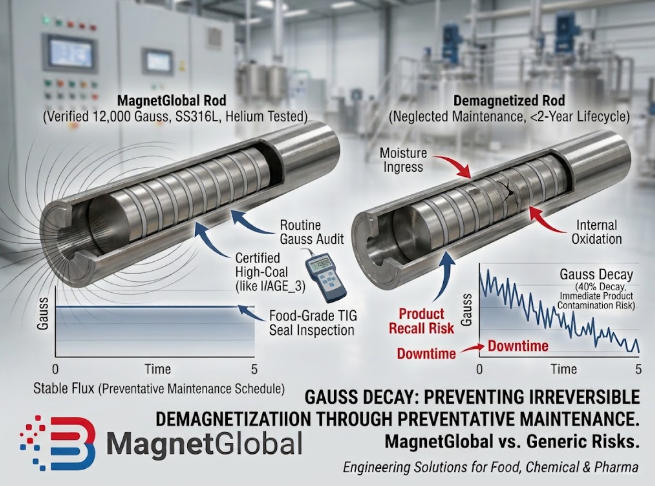
If the external stainless steel sleeve (SS304/SS316L) develops pinhole leaks due to abrasive slurry wear or sub-standard TIG welding, moisture and corrosive cleaning agents (CIP chemicals) will penetrate the magnetic core. Raw NdFeB rapidly oxidizes when exposed to moisture, forming iron oxide (rust) and destroying the magnetic domain alignment.
4. External Reverse Magnetic Fields
Exposing permanent magnetic separators to strong external electromagnetic fields (such as proximity to unshielded high-power motors, transformers, or induction welding equipment) can exert a demagnetizing force on the internal NdFeB cores.
Preventative Maintenance & Equipment Care Best Practices
To ensure compliance with HACCP, BRCGS, and ISO quality standards, processing facilities should implement the following maintenance procedures:
- Establish Regular Gauss Audits: Utilize a calibrated Digital Hall-Effect Gaussmeter with an axial probe to measure and record surface Gauss strength at designated high-flux pole points every 3 to 6 months.
- Implement Safe Cleaning Procedures: Handle magnetic grates and drawers with care during manual cleaning. Avoid metal scraper tools that can scratch protective 316L stainless steel cladding.
- Inspect Seal Integrity: Inspect end-cap TIG welds and outer tubing routinely for abrasive wear, pitting, or crack formation, especially when processing highly abrasive materials like quartz sand or glass cullet.
- Match Temperature Specs: Always verify line operating temperatures (including peak CIP steam cleaning cycles) before selecting magnetic separator specifications.
- Engineering Premium Magnetic Solutions with MagnetGlobal
At MagnetGlobal (a specialized high-end export brand of Dongtai Yousheng Magnetic & Electric Co., Ltd.), we eliminate premature Gauss degradation at the engineering stage. Our industrial magnetic rods and grid separators feature:
- Hermetically Sealed Construction: High-density TIG welding and 100% helium leak testing to guarantee zero liquid or moisture ingress.
- Custom Temperature Ratings: Precision-selected Dy/Tb-doped Neodymium cores tailored to withstand high operating temperatures up to 200°C without permanent flux loss.
- Superior Corrosion Resistance: Food-grade sanitary polished SS316L stainless steel sleeves resistant to aggressive CIP acids and alkalis.
- Verified High Gauss Ratings: Certified surface magnetic field strengths reaching up to 12,000 Gauss – 14,000 Gauss for fine contaminant extraction.