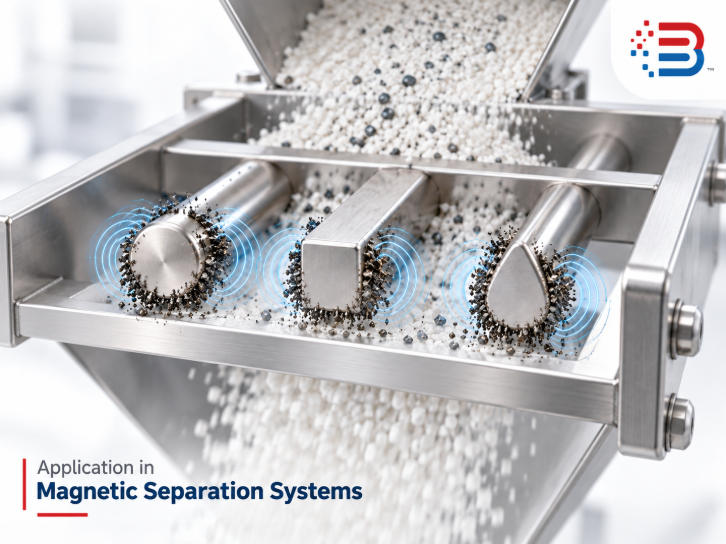
Magnetic rods are widely used to capture ferrous contaminants from powders, granules, liquids, and other bulk materials. They can be installed individually or incorporated into magnetic grates, drawer-type magnetic separators, chutes, filters, and other magnetic separation systems.
When selecting a magnetic rod, magnetic strength, magnet grade, stainless steel material, dimensions, and surface finish are usually important considerations. However, rod shape can also affect how the magnetic element fits into the equipment, interacts with material flow, and is accessed for cleaning.
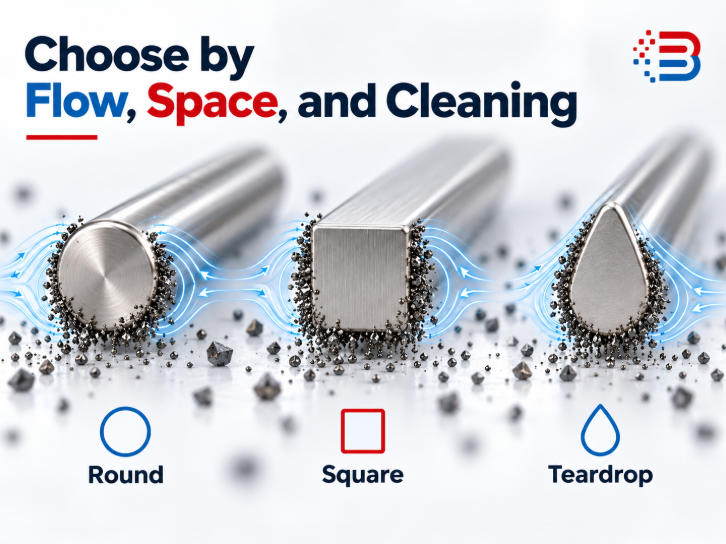
Round magnetic rods are the most common and versatile option. Square or rectangular magnetic bars can provide additional flexibility in compact or customized equipment layouts, while teardrop magnetic rods can be considered when material flow and potential accumulation around the magnetic element are important.
Quick Comparison: Round vs. Square vs. Teardrop Magnetic Rods
| Factor | Round Magnetic Rod | Square / Rectangular Magnetic Bar | Teardrop Magnetic Rod |
|---|---|---|---|
| Best suited for | General-purpose magnetic separation | Compact or customized equipment | Flow-sensitive applications |
| Standard equipment integration | Highly suitable | Application-dependent | Application-dependent |
| Installation flexibility | High | High | Moderate |
| Space utilization | Good | High | Good |
| Material flow | Smooth | Depends on equipment geometry | Flow-oriented profile |
| Cleaning accessibility | Generally simple | Depends on design | Generally accessible |
| Custom equipment integration | High | High | High |
For many standard applications, round magnetic rods are the most practical starting point.
Square or rectangular magnetic bars are worth considering when installation space or structural positioning is important.
Teardrop magnetic rods are more specialized and may be useful where material flow, spacing, or potential material accumulation needs additional attention.
However, rod shape alone does not determine magnetic separation performance. Magnetic strength, magnetic circuit design, spacing, material characteristics, flow rate, contamination level, and the overall separator design should all be considered together.
What Is a Magnetic Rod?
A magnetic rod, also known as a magnetic bar or magnetic filter rod, is a magnetic separation component designed to attract and retain ferrous particles from a material stream.
A typical magnetic rod contains a permanent magnetic assembly enclosed within a stainless steel tube. High-performance neodymium magnets are commonly used when strong magnetic fields are required.
Depending on the application, the outer tube can be manufactured from materials such as SUS304 or SUS316L stainless steel and supplied with different surface finishes.
Magnetic rods can be used individually or incorporated into equipment such as:
- Magnetic grates
- Magnetic grids
- Drawer-type magnetic separators
- Magnetic chutes
- Magnetic filters
- Powder magnetic separators
- Custom magnetic separation systems
As material passes around or across the magnetic surface, ferrous particles are attracted to the magnetic rod and retained until the rod is cleaned.
The basic separation principle remains similar across different rod shapes, but geometry can influence equipment integration, material flow, spacing, and maintenance.
Round Magnetic Rods
Round magnetic rods have a cylindrical cross-section and are the most widely used design for magnetic separation applications.
Their simple geometry makes them suitable for a broad range of standard and customized magnetic separation systems.
Advantages of Round Magnetic Rods
Smooth material path
The cylindrical surface provides a smooth path for powders, granules, and other materials moving around the magnetic element.
Easy cleaning
The continuous surface can make the rod relatively straightforward to wipe or clean when captured contaminants need to be removed.
Flexible installation
Round magnetic rods can be installed individually or arranged in parallel rows to form magnetic grates and grids. They are also commonly incorporated into drawer-type magnetic separators.
Wide application range
Their simple geometry makes them suitable for food processing, plastics, chemicals, agricultural products, ceramic materials, pharmaceuticals, mineral processing, and other bulk-material applications.
Easy customization
Manufacturers can adjust parameters such as:
-
- Diameter
- Length
- Magnetic strength
- Magnet configuration
- Stainless steel material
- Surface finish
- End configuration
- Mounting method
When Should You Choose a Round Magnetic Rod?
A round magnetic rod is generally a practical choice when:
- The equipment uses a conventional magnetic grate or grid design.
- Installation space is not unusually restricted.
- Easy cleaning is important.
- A versatile magnetic element is required.
- The separator does not require a specialized rod profile.
For general-purpose magnetic separation, round rods are often the most straightforward option.
Square and Rectangular Magnetic Bars
Square and rectangular magnetic bars use flat-sided profiles rather than cylindrical tubes.
Their geometry can provide additional flexibility when magnetic elements need to fit into a defined space or be integrated into equipment designed around specific dimensions.
Advantages of Square Magnetic Bars
Efficient use of installation space
Flat-sided profiles can be useful when multiple magnetic elements need to be arranged within a compact separation area.
Depending on the equipment design, square or rectangular bars may be positioned closely while maintaining a structured layout.
Stable structural positioning
Flat surfaces can make integration into customized supporting frames or equipment structures more straightforward.
Suitable for customized equipment
Square and rectangular magnetic bars can be particularly useful when the magnetic separation system is designed around specific dimensional or structural requirements rather than a standard magnetic grate.
When Should You Choose a Square or Rectangular Magnetic Bar?
Square or rectangular magnetic bars may be suitable when:
- Available installation space is limited.
- Equipment dimensions require a specific magnetic element profile.
- Several magnetic elements need to be positioned within a compact area.
- Structural positioning is an important part of the separator design.
- The equipment is highly customized.
Typical applications can include magnetic grates, drawer-type separators, powder separation equipment, compact processing systems, and customized magnetic separation systems.
Teardrop Magnetic Rods
Teardrop magnetic rods, sometimes referred to as tear drop or pear-shaped magnetic rods, use a streamlined profile that differs from both cylindrical and rectangular designs.
The profile typically combines a wider section with a narrower section, allowing the magnetic element to interact differently with the surrounding material flow.
This design can be considered when material flow, spacing, and potential accumulation around the magnetic element are important parts of the separator design.
Advantages of Teardrop Magnetic Rods
Streamlined material flow
The curved profile can provide a smoother transition for material moving around the magnetic element.
This can be useful in certain powder or granular material applications where flow behavior needs to be carefully considered.
Reduced potential for material accumulation
The geometry may help reduce certain areas where powders or granules could otherwise collect around the magnetic element.
The actual effect depends on the material characteristics and the design of the complete separator.
Suitable for specialized equipment
Teardrop magnetic rods can be incorporated into customized magnetic grates and separation systems where conventional round rods do not provide the preferred geometry.
When Should You Choose a Teardrop Magnetic Rod?
A teardrop profile may be worth evaluating when:
- Material flow is a major design consideration.
- The process handles powders or granular materials.
- Material accumulation around magnetic elements is a concern.
- The equipment requires a specialized magnetic rod profile.
- A conventional round or rectangular rod does not suit the separator geometry.
Teardrop magnetic rods are therefore more application-specific than conventional round rods and should be evaluated as part of the overall equipment design.
Does Magnetic Rod Shape Affect Separation Performance?
Yes, but rod shape should be considered as one part of the complete magnetic separation system.
The geometry primarily affects how the magnetic element interacts with the material stream and how it can be integrated into the equipment.
For example:
- Round magnetic rods work well in many conventional magnetic grates because they are easy to arrange and provide a smooth cylindrical surface.
- Square and rectangular magnetic bars can provide additional layout flexibility in equipment with limited space or specific structural requirements.
- Teardrop magnetic rods can be considered where material flow and potential accumulation require additional attention.
Changing rod shape does not automatically increase magnetic strength.
Effective ferrous contamination removal depends on several factors, including:
- Magnetic strength
- Magnet grade
- Magnetic field distribution
- Rod diameter or cross-section
- Material flow rate
- Particle size
- Material density
- Moisture content
- Rod spacing
- Number of magnetic stages
- Cleaning method
For this reason, rod geometry should always be selected together with the magnetic and mechanical parameters of the complete system.
How to Choose the Right Magnetic Rod Shape
Selecting the right shape starts with understanding both the processed material and the equipment.
1. Consider the Material
Different materials behave differently when they move through magnetic separation equipment.
Fine powders may be more likely to bridge, accumulate, or adhere to surfaces, while larger granules may require different spacing between magnetic elements.
Important material characteristics include:
- Particle size
- Density
- Moisture content
- Flowability
These characteristics should be evaluated before selecting the magnetic rod geometry.
2. Evaluate the Available Installation Space
Available space can strongly influence separator design.
If several magnetic elements need to fit inside a compact chamber, square or rectangular magnetic bars may provide additional layout flexibility.
If sufficient space is available and the equipment uses a conventional separator configuration, round magnetic rods are often a practical solution.
3. Consider Material Flow
For powder and bulk-material applications, the magnetic elements should capture ferrous contaminants without unnecessarily restricting the material path.
Where material flow behavior or accumulation is particularly important, teardrop or other customized profiles may be worth evaluating.
4. Consider Cleaning and Maintenance
Magnetic rods eventually need to be cleaned so that accumulated ferrous contamination can be removed.
If cleaning is frequent, easy access, smooth surfaces, and practical mounting can improve maintenance efficiency.
For food, pharmaceutical, and other hygienic applications, stainless steel grade and surface finish should also be selected according to the requirements of the application.
5. Decide Whether You Need a Standard or Customized Design
Round magnetic rods can satisfy many standard separation requirements.
More specialized equipment may require customized dimensions or profiles.
Depending on the application, magnetic rods can be customized in terms of:
- Shape
- Diameter or cross-section
- Length
- Magnetic strength
- Magnet grade
- Magnet configuration
- Stainless steel material
- Surface finish
- End configuration
- Mounting method
Providing detailed equipment and material information can help the manufacturer recommend a more suitable configuration.
What Information Should You Provide When Selecting Magnetic Rods?
Before requesting a magnetic rod or customized separator design, it is helpful to provide information such as:
- Material type
- Particle size
- Material flow characteristics
- Processing capacity
- Equipment dimensions
- Available installation space
- Required magnetic strength
- Contamination-removal requirements
- Cleaning requirements
The more accurately the application is described, the easier it is to evaluate the appropriate rod geometry and overall separator configuration.
Frequently Asked Questions About Magnetic Rod Shapes
Are round magnetic rods better than square magnetic bars?
Not necessarily.
Round magnetic rods are highly versatile and suitable for many standard applications.
Square or rectangular magnetic bars can provide advantages when installation space, positioning, or customized equipment geometry is important.
The better option depends on the complete application rather than rod shape alone.
Which magnetic rod shape is best for powders?
There is no single rod shape that is best for every powder application.
The choice depends on factors such as particle size, flowability, moisture content, processing capacity, equipment layout, and cleaning requirements.
Round rods are widely used for standard powder-processing systems, while teardrop profiles may be considered when material flow or potential accumulation around the magnetic element requires additional attention.
Are teardrop magnetic rods suitable for powder applications?
Yes, they can be considered for certain powder-processing applications.
Their profile can be useful where material flow and equipment geometry are important.
However, the design should still be evaluated according to the powder characteristics, processing capacity, magnetic requirements, and separator structure.
Does magnetic rod shape affect magnetic strength?
Rod shape alone does not determine magnetic strength.
Magnet grade, magnetic circuit design, magnetic field distribution, rod dimensions, and other design parameters also affect the magnetic characteristics of the finished component.
Shape should therefore be evaluated as part of the complete magnetic separator design.
What materials are magnetic rods usually made from?
The outer tube is commonly manufactured from stainless steel such as SUS304 or SUS316L.
The internal magnetic assembly can use permanent magnets such as neodymium magnets when high magnetic strength is required.
The appropriate materials depend on the operating environment and application requirements.
Can magnetic rods be customized?
Yes.
Magnetic rods can be customized in terms of dimensions, magnetic strength, magnet configuration, stainless steel material, surface finish, end design, mounting method, and other structural parameters.
Round, square, rectangular, and teardrop profiles can all be considered depending on the equipment requirements.
Conclusion
There is no single magnetic rod shape that is best for every magnetic separation application.
Round magnetic rods are the most versatile choice for conventional magnetic separation systems and provide flexible installation, smooth surfaces, and straightforward cleaning.
Square and rectangular magnetic bars can be advantageous when installation space, structural positioning, or customized equipment integration is important.
Teardrop magnetic rods provide a more specialized geometry for applications where material flow and potential accumulation around the magnetic element require additional consideration.
However, shape should never be selected independently.
Magnetic strength, magnetic circuit design, material characteristics, flow rate, rod spacing, processing capacity, installation space, and cleaning requirements should all be evaluated as part of the complete magnetic separation system.
If you are designing a new magnetic separator or replacing existing magnetic elements, provide your material type, particle size, processing capacity, equipment dimensions, installation space, and magnetic separation requirements.
Our technical team can use this information to help evaluate a suitable magnetic rod shape and configuration for your application.