The heavy rare earth supply gap in 2026 is not a shortage of announcements. It is a shortage of qualified, scalable supply — particularly dysprosium (Dy) and terbium (Tb) — outside China.
That distinction matters for anyone sourcing high-performance NdFeB magnets. Standard NdFeB grades rely primarily on neodymium and praseodymium, while higher-temperature and higher-coercivity grades may use dysprosium or terbium, including through alloying or grain-boundary diffusion, to improve resistance to demagnetization under demanding operating conditions.
Western investment in rare earth mining, separation, metallization, alloy production, and magnet manufacturing has accelerated significantly. But investment, construction, commissioning, qualification, and commercial-scale supply are different milestones.
Progress is real. The question for magnet buyers is how much of that progress has reached the point where material is qualified, repeatable, commercially available, and ready to support production programs.
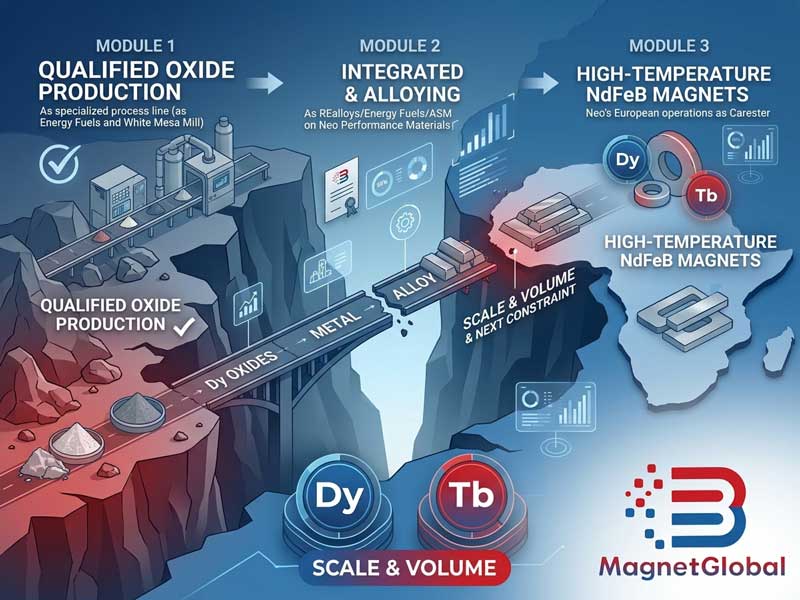
What Is Actually Moving in 2026
Several developments this year show that the non-China rare earth supply chain is becoming more tangible.
In July, REalloys and JS Link signed a non-binding letter of intent to evaluate an integrated North American rare earth magnet platform spanning feedstock, separation, metallization, and permanent magnet manufacturing. The proposed collaboration reflects an increasingly common strategy: rather than solving only mining or separation, companies are trying to connect multiple stages of the magnet supply chain.
Energy Fuels has moved further downstream as well. In late August, the company completed its acquisition of Australian Strategic Materials, adding established rare earth metal and alloy capabilities to its broader mine-to-magnet strategy.
At its White Mesa Mill in Utah, Energy Fuels has also begun construction of commercial-scale heavy rare earth oxide capacity. The planned expansion includes future production capacity for dysprosium and terbium oxides.
Importantly, qualification is beginning to move too. In August, Energy Fuels announced that terbium oxide produced at White Mesa had passed qualification for use by a major Japan-based rare earth permanent magnet manufacturer.
That is a meaningful milestone because it demonstrates the difference between planned capacity and material that has actually passed a customer’s technical requirements.
Europe is also building additional heavy rare earth capability.
Neo Performance Materials commissioned a small-scale heavy rare earth separation line at its Silmet facility in Estonia in April. The line has produced separated dysprosium and terbium process solutions, with the company working toward stable product purity and routine production.
At the end of August, Neo also announced a partnership with Carester that is expected to provide separated dysprosium and terbium oxides from the Caremag project for Neo’s European magnet operations.
These developments matter. But they do not mean the heavy rare earth supply gap has disappeared.
They show something more precise: the Western supply chain is moving from announcements toward qualification and industrialization, but commercial scale is still developing unevenly across different stages of the chain.
Why “Qualified Supply” Matters More Than Announced Capacity
A rare earth project can be financed without producing material.
A separation plant can be built without consistently producing material at the required purity.
A batch of oxide can meet specifications without the downstream metal, alloy, or finished magnet automatically being qualified for the same customer’s application.
This is why buyers should look beyond nameplate capacity.
For demanding magnet applications, commercial qualification can involve several layers:
- verified chemical purity and composition;
- consistency across repeated production runs;
- control of impurities and process variation;
- validation of downstream metal or alloy performance;
- finished magnet testing against magnetic, thermal, mechanical, and dimensional requirements;
- customer-specific approval processes before volume production.
The exact process varies by application and customer. Automotive, aerospace, industrial, and other high-reliability markets may impose different qualification requirements.
In some cases, qualification can become as important as — and sometimes longer than — physical commissioning.
Energy Fuels’ recent terbium milestone is a good example of why qualification deserves separate attention. Customer approval is a significant commercial step, but qualification of one material with one customer does not automatically mean that every downstream product, magnet grade, or production volume is immediately available.
For sourcing teams, the useful question therefore is not simply:
“How much capacity has been announced?”
It is:
“How much material is producing consistently, has passed the necessary qualification steps, and is available at the scale our program requires?”
Why Dysprosium and Terbium Remain the Harder Bottleneck
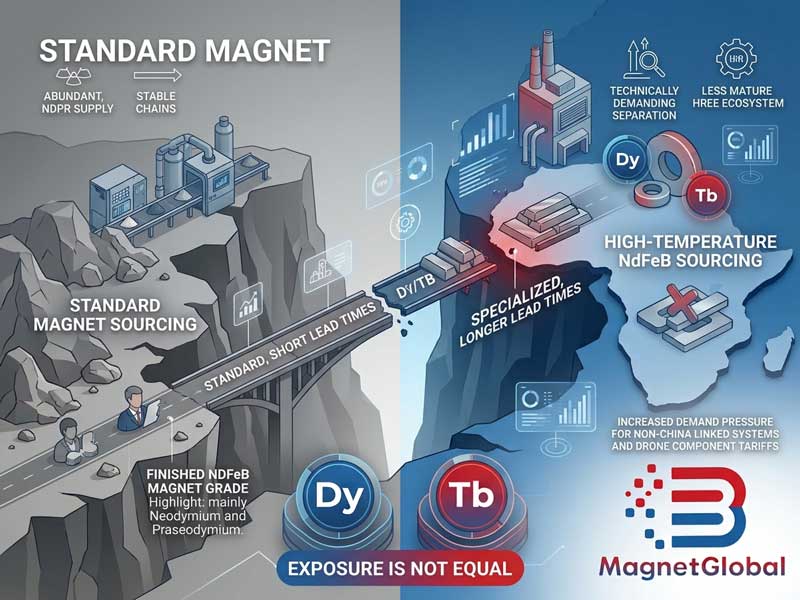
Not every NdFeB magnet has the same exposure to heavy rare earth supply.
Many standard NdFeB grades depend primarily on neodymium and praseodymium. Higher-temperature or higher-coercivity applications may require dysprosium or terbium to help maintain magnetic performance under more demanding operating conditions.
Modern magnet manufacturing can reduce heavy rare earth consumption through techniques such as grain-boundary diffusion, optimized microstructure, and lower-HREE formulations. That means a high-performance magnet does not necessarily require the same Dy or Tb content as an older design.
But where Dy or Tb is still required, the sourcing challenge remains more difficult than simply securing NdPr.
Heavy rare earths occur in lower concentrations, separation is technically demanding, and the non-China processing ecosystem remains less mature.
The U.S. Geological Survey’s 2026 heavy rare earth reporting, for example, identifies terbium, dysprosium, holmium, erbium, thulium, ytterbium, and lutetium as heavy rare earth elements. It also notes that, while several companies have been developing processing and refining capacity, sustained commercial-scale U.S. production remained limited entering 2026.
For clarity, samarium is not classified here as a heavy rare earth element, although it remains strategically important for other permanent magnet technologies, particularly samarium-cobalt magnets.
The distinction matters because a buyer asking generally about “rare earth supply” may receive an answer that says little about the actual risk associated with a specific magnet grade.
Qualification Is Improving — But Scale Is the Next Test
The picture in September 2026 is therefore more nuanced than simply saying that Western heavy rare earth supply is not moving.
It is moving.
Qualification milestones are emerging. Separation capacity is being commissioned. New metallization and alloy capabilities are being integrated. Magnet plants are ramping. Governments and private investors are providing substantial capital.
But those developments are happening at different speeds.
A supply chain can have a qualified oxide but still face constraints in metalmaking.
It can have metalmaking capacity but insufficient qualified feedstock.
It can have a magnet plant but still depend on imported Dy or Tb.
And it can have qualified material without yet having enough volume to support a large production program at predictable cost and lead time.
That is the gap sourcing teams should watch over the next several years: not simply whether Western capacity exists, but whether qualified supply expands through every critical stage from separated rare earth material to finished magnet.
Policy Can Change Demand Faster Than Supply
Government policy is adding another layer of pressure.
In August 2026, the United States announced new Section 232 tariffs covering certain unmanned aircraft systems and components, including tariffs of up to 100% on selected categories.
Measures like these are intended in part to encourage domestic production and reduce dependence on vulnerable foreign supply chains.
But tariffs can change sourcing incentives much faster than new industrial capacity can be qualified.
For manufacturers of motors, actuators, drones, robotics, automotive systems, and other products using permanent magnets, the result can be a temporary mismatch: demand for non-China-linked supply increases before enough alternative material has reached commercial scale.
That mismatch can affect:
- lead times;
- pricing;
- minimum order quantities;
- qualification schedules;
- material traceability requirements;
- availability of particular high-temperature magnet grades.
This is why supply-chain diversification should be treated as an engineering and procurement issue, not simply a question of country of origin.
What This Means for Your Magnet Sourcing Decisions
For magnet buyers, there are several practical implications.
- Specify the magnet grade you actually need.
Do not treat all NdFeB magnets as having the same supply risk.
If your application can operate reliably with a standard grade, its exposure to dysprosium and terbium supply constraints may be lower than that of a high-temperature, high-coercivity grade.
- Do not equate announced capacity with available supply.
Funding, construction, commissioning, qualification, and commercial production are separate milestones.
When evaluating a new supply source, determine which stage it has actually reached.
- Ask what is qualified — not simply what is produced.
A supplier may have access to separated oxide without having a qualified downstream metal or alloy route for your finished magnet.
Qualification should be considered across the complete chain relevant to your product.
- Ask where the heavy rare earth content originates.
For Dy- or Tb-dependent magnet grades, understand the origin of the heavy rare earth material and whether alternative sources have already been validated.
- Build sourcing timelines around your specific grade and application.
Lead times for a standard NdFeB grade may not reflect availability for a specialized high-temperature grade.
Critical programs should include additional time for qualification, material substitutions, or alternative-source validation where appropriate.
What Should You Ask Your Magnet Supplier?
When supply security matters, a few specific questions are more useful than asking whether a supplier has “non-China rare earths.”
Ask:
- What operating temperature and coercivity does my application actually require?
- Does the recommended magnet grade require dysprosium or terbium?
- Can the required performance be achieved with a reduced-HREE design?
- Where do the Dy- or Tb-containing raw materials originate?
- Is the material coming from pilot production or routine commercial production?
- Which stages of the supply chain have already been qualified?
- Has the finished magnet grade been validated for applications similar to mine?
- Could a change in raw-material source trigger requalification?
- What lead-time assumptions should we use for volume production?
These questions turn a broad geopolitical supply-chain issue into something that can actually be managed through engineering and procurement.
The Most Important Distinction for Buyers
The heavy rare earth supply chain is clearly changing.
Compared with only a few years ago, there are more credible Western projects, more investment, more separation capability, more downstream integration, and now genuine qualification milestones.
But buyers should resist the temptation to interpret every new project announcement as immediately interchangeable supply.
The real benchmark is qualified, repeatable, scalable material that can move through the complete magnet manufacturing chain and meet the requirements of a specific application.
For dysprosium- and terbium-dependent NdFeB grades, that benchmark is improving — but it remains considerably more constrained than the headlines around new capacity might suggest.
Talk to MagnetGlobal About Your Magnet Grade Requirements
Heavy rare earth supply risk does not always need to be solved through procurement alone. In some applications, the more effective solution is to revisit the magnet specification itself.
If you’re not sure whether your application genuinely requires a dysprosium- or terbium-containing high-temperature NdFeB grade, or whether the required performance can be achieved with a standard or reduced-HREE grade, contact the MagnetGlobal engineering team.
Our team can review factors such as operating temperature, coercivity requirements, magnet geometry, performance targets, and application conditions to help determine an appropriate magnet grade.
Choosing the right specification can help balance magnetic performance, cost, lead time, and exposure to the most constrained parts of the rare earth supply chain.
Frequently Asked Questions
Q: Why are dysprosium and terbium used in NdFeB magnets?
A: Dysprosium and terbium can be used to improve coercivity and resistance to demagnetization, particularly when NdFeB magnets must perform at elevated temperatures. Modern manufacturing methods such as grain-boundary diffusion can also help achieve the required performance while reducing total heavy rare earth consumption.
Q: What does “qualified rare earth supply” mean?
A: Qualified supply generally refers to material that has passed the technical and quality requirements needed for a specific downstream customer or application. Qualification can include purity, composition, production consistency, processing performance, and final product validation. Qualification requirements vary by customer and application.
Q: Are all high-temperature NdFeB magnets dependent on dysprosium or terbium?
A: No. The required Dy or Tb content depends on magnet grade, operating conditions, magnet design, manufacturing process, and performance requirements. Reduced-HREE formulations and grain-boundary diffusion can sometimes reduce or avoid the amount of heavy rare earth material required.
Q: Why is heavy rare earth supply harder to diversify than NdPr supply?
A: Dysprosium and terbium are less abundant than the major light rare earth elements used in NdFeB magnets, and the separation and downstream processing infrastructure outside China is less mature. New projects are advancing, but qualification and commercial scale remain important constraints.
Q: Does new rare earth production capacity immediately reduce magnet supply risk?
A: Not necessarily. New capacity must still achieve stable production, meet required specifications, integrate with downstream metal, alloy, and magnet manufacturing, and complete any required customer qualification before it can reliably support volume magnet production.
This article reflects publicly available industry information as of September 3, 2026 and is intended as general technical and sourcing background. Supply conditions, project timelines, qualification status, tariffs, and regulations can change. Confirm current requirements and supply availability before making procurement or engineering decisions.