What procurement teams need to verify before ordering neodymium magnets from China
If you have sourced neodymium magnets from China for years without a customs issue, 2026 is a good time to review your purchasing and compliance process.
NdFeB magnets have not been broadly banned from export. However, China introduced export controls in April 2025 covering specified medium and heavy rare earth-related items, including NdFeB permanent magnet materials containing dysprosium (Dy) or terbium (Tb). For overseas buyers, this means that the actual composition of a magnet can matter just as much as its grade name, dimensions or magnetic performance.
A part that looks identical to a magnet you purchased several years ago may now require additional export-control review depending on its composition.
This guide explains what overseas buyers should verify, where common misunderstandings arise, and what questions to ask a Chinese magnet supplier before releasing a purchase order.
| Important: This article provides general procurement and compliance information and is not legal advice. Export-control requirements can change, and the classification of a specific shipment should be confirmed with the exporter and, where appropriate, qualified compliance professionals. |
At a Glance
- NdFeB magnets are not subject to a blanket export ban.
- China’s April 2025 controls include NdFeB permanent magnet materials containing dysprosium or terbium.
- A commercial grade such as H, SH, UH or EH does not by itself determine export-control status.
- Buyers should verify elemental composition, export-control classification and documentation before shipment.
- Additional rare-earth export-control measures announced in October 2025 are currently suspended through November 10, 2026, so buyers planning longer-term supply agreements should continue monitoring regulatory developments.
China’s Ministry of Commerce has also stated that its export-control measures are export controls rather than a general export ban and that eligible applications may receive licences. Official MOFCOM announcement
Rare Earth Magnets Are Not Banned from Export
The first point is worth making clearly.
China continues to export rare earth magnets for applications including electric motors, wind energy, industrial automation, sensors, consumer electronics and other equipment.
What changed is the regulatory framework surrounding certain materials.
On April 4, 2025, China’s Ministry of Commerce and General Administration of Customs announced export controls covering specified medium and heavy rare earth-related items.
Among the listed categories are:
- Terbium-containing NdFeB permanent magnet materials
- Dysprosium-containing NdFeB permanent magnet materials
- Certain other rare earth metals, alloys, oxides, compounds and related products
Exporters of controlled items are required to apply for the appropriate export licence.
The official announcement also states that controlled permanent magnet materials include magnets and magnetic powders. MOFCOM Announcement No.18 of 2025
For buyers, the practical takeaway is simple:
Do not assume that every NdFeB magnet has the same export-control status.
The composition of the specific magnet matters.
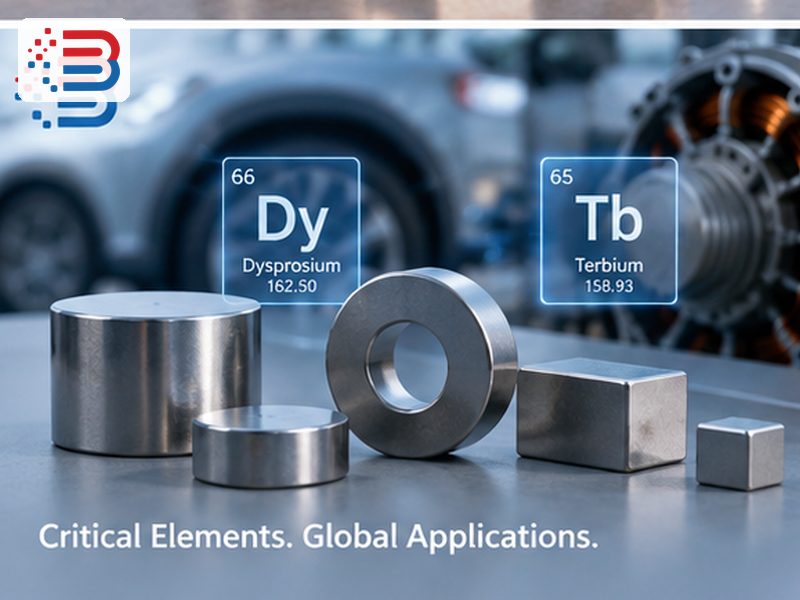
Why Dysprosium and Terbium Matter
Dysprosium and terbium are commonly associated with high-performance NdFeB magnets because they can help improve coercivity and resistance to demagnetisation at elevated temperatures.
They are therefore particularly relevant to applications such as:
- Electric and hybrid vehicle motors
- Industrial servo motors
- High-temperature motors
- Generators
- Certain aerospace applications
- Automation equipment
- Equipment operating under demanding thermal conditions
However, application and grade should only be treated as screening indicators.
They do not, by themselves, determine whether a magnet is controlled.
Under the April 2025 rules, NdFeB permanent magnet materials containing dysprosium or terbium are among the specifically listed controlled categories. The correct approach is therefore to verify the material composition and current export classification rather than relying solely on a commercial grade name. Official controlled-items list
Why the Grade Name Alone Is Not Enough
Sintered NdFeB magnets are commonly supplied under grades such as N, M, H, SH, UH and EH.
These classifications primarily describe magnetic and temperature-performance characteristics. They are not chemical composition certificates.
Two manufacturers may achieve similar magnetic performance using different alloy formulations or production processes.
This becomes particularly important with technologies such as grain boundary diffusion (GBD).
GBD can introduce heavy rare earth elements more selectively around grain boundaries instead of relying entirely on conventional bulk alloying. This can reduce the amount of heavy rare earth material required to achieve a given coercivity target.
As a result, magnets with similar commercial performance classifications may not necessarily have identical Dy or Tb content.
For procurement teams, the distinction is important:
| A datasheet tells you how a magnet performs. A composition report helps tell you what the magnet contains. |
Both matter, but they answer different questions.
A Real 2026 Enforcement Case Shows Why Composition Matters
A public enforcement case in China illustrates the risk clearly.
According to a May 2026 disclosure, a Chinese listed company exported a batch of permanent magnets on April 10, 2025.
The declared shipment value was approximately RMB 201,791.
Customs subsequently determined that the magnets contained 1.2% dysprosium, making them dysprosium-containing NdFeB permanent magnet materials subject to export control.
The shipment had been exported without the required licence.
The company ultimately received an administrative fine of RMB 910,000 — approximately 4.5 times the declared value of the goods. Public case report
The useful lesson for buyers is not the percentage itself.
The lesson is that procurement specifications, material declarations and export documentation need to agree with the actual composition of the goods being shipped.
A familiar grade name or long purchasing history should not replace material verification.
What About the October 2025 Rare Earth Rules?
China announced additional rare earth export-control measures in October 2025.
Among other provisions, the framework addressed certain foreign-produced products containing Chinese-origin controlled rare earth materials. One provision applied to specified foreign-manufactured items where controlled Chinese-origin material accounted for 0.1% or more of the value.
See the official October 2025 framework: China Export Control Information Network
Those additional measures were subsequently suspended.
In April 2026, China’s Ministry of Commerce confirmed that the relevant export-control measures announced on October 9, 2025 were suspended until November 10, 2026. Official April 2026 confirmation
For procurement teams planning contracts that extend beyond that date, the important point is not to assume what will happen next.
- Monitor subsequent regulatory announcements.
- Review contracts that extend beyond November 2026.
- Maintain traceability of material origin and composition.
- Ask suppliers how they are monitoring changes in export-control requirements.
The status of the suspended measures after November 10, 2026 will depend on subsequent policy decisions.

Why Supply-Chain Concentration Makes Compliance More Important
Rare earth magnet supply chains remain highly concentrated.
According to the International Energy Agency, China accounted for approximately:
- 91% of global refined output of magnet rare earths in 2024
- 94% of global sintered permanent magnet production in 2024
The magnet rare earth figures cover key elements including neodymium, praseodymium, dysprosium and terbium. IEA Rare Earth Elements report
Alternative capacity is developing in other regions, but the current concentration means that changing suppliers or rebuilding a qualified magnet supply chain can take time.
For buyers, this makes early supplier qualification more valuable than reacting after a shipment has already encountered a compliance problem.
A 30-Second Buyer Self-Check
Before placing your next NdFeB magnet order, ask these questions.
1. Does the magnet operate in a high-temperature application?
A high-temperature application may increase the likelihood that higher-coercivity materials or heavy rare earth elements are involved. This is a screening signal — not a compliance determination.
2. Is the magnet specified as H, SH, UH, EH or another high-coercivity grade?
Again, grade alone does not prove Dy or Tb content. It should prompt the buyer to request composition information.
3. Do you have an elemental composition report?
A magnetic performance report and a chemical composition report serve different purposes. For compliance review, the latter may be essential.
4. Has the supplier confirmed the export-control status of the exact part?
Ask about the actual part number and composition being quoted, rather than a generic product family.
5. Do the commercial and technical documents match?
The purchase specification, composition report, commercial invoice, packing list, test documentation and export declaration should describe the goods consistently.
If you cannot confidently answer these questions, resolve them before the shipment reaches customs.
Five Questions to Ask Your Chinese NdFeB Magnet Supplier
A capable supplier should be able to help buyers establish a clear documentation trail.
1. What is the elemental composition of this magnet?
Ask for composition information for the exact material being quoted, especially where Dy or Tb may be present.
Avoid relying only on general statements such as:
- “low Dy”
- “trace heavy rare earth”
- “standard high-temperature grade”
The documentation should be specific enough to support proper classification.
2. How is the product classified for export?
Ask the supplier to confirm:
- Product description
- Applicable customs classification
- Whether the item falls within a controlled category
- Whether an export licence is required
- Which supporting documents are required
For controlled items, China’s official rules require exporters to identify controlled status in customs declarations and provide the relevant dual-use control number. MOFCOM Announcement No.18 of 2025
3. Does the supplier have experience handling controlled shipments?
If a licence is required, ask whether the supplier has previously handled similar applications.
Questions can include:
- What information is normally required?
- Which party prepares the end-use documentation?
- What lead time should be built into the order?
- What information will the buyer need to provide?
Do not treat historical lead times as guarantees, because licensing requirements and processing conditions can change.
4. Are lower-heavy-rare-earth alternatives technically possible?
In some applications, the engineering specification may be achievable using:
- Optimised magnet geometry
- Grain boundary diffusion
- Alternative material formulations
- Magnetic circuit optimisation
- Different thermal-management approaches
The goal is not to redesign a product purely to avoid regulation.
The goal is to understand whether the required magnetic and thermal performance can be achieved with a technically appropriate material that also simplifies sourcing.
5. Are all documents consistent?
Review the complete document chain.
At minimum, this may include:
- Purchase specification
- Material or composition report
- Magnetic performance report
- Commercial invoice
- Packing list
- Customs documentation
- Export licence documentation where applicable
A technically correct product can still become difficult to ship if the documentation is incomplete or inconsistent.
Buyers Should Also Understand What Is — and Is Not — Covered
Another reason not to rely on simplified statements such as “rare earth products are controlled” is that regulatory treatment can depend on the form of the product.
China’s export-control authority has published additional guidance explaining that certain deeply processed downstream products containing controlled magnetic components may generally fall outside the scope of the April 2025 Announcement No.18. Official guidance
Examples given in official guidance include certain assembled motor components, sensors and downstream products containing magnetic parts.
Classification should be based on the actual product being shipped, not just the presence of a magnet somewhere inside it.
When in doubt, the exporter should determine the appropriate classification under the current rules.
A Better Procurement Process for 2026
For overseas buyers, magnet sourcing in 2026 should include compliance earlier in the procurement cycle.
Step 1 — Define the application
Confirm operating temperature, magnetic performance, mechanical requirements and expected service conditions.
Step 2 — Select the magnet grade
Choose the appropriate grade based on engineering requirements.
Step 3 — Verify composition
Request the relevant elemental or material composition information.
Step 4 — Confirm export classification
Ask the supplier to determine whether the item is controlled and whether licensing is required.
Step 5 — Review documentation
Ensure commercial, technical and export documents are consistent.
Step 6 — Allow compliance lead time
If licensing is required, account for that process before committing to production or delivery dates.
Step 7 — Recheck before repeat orders
Do not assume that a classification completed several years ago remains sufficient after regulatory or material changes.
This turns export compliance from a last-minute customs problem into a normal part of supplier qualification.
Where MagnetGlobal Stands
At MagnetGlobal, our manufacturing entity, Dongtai Yousheng Magnetic & Electric, produces sintered NdFeB magnets across a broad range of grades and applications.
For grades where heavy rare earth content is relevant, we can provide elemental composition information during the quotation and technical review process.
Where an application may be achievable with lower Dy loading or another suitable material approach, our engineering team can evaluate the operating conditions and discuss alternative grade options.
For buyers reviewing their magnet supply chain, the most useful starting information is:
- Magnet drawing
- Required grade, if already specified
- Operating temperature
- Application
- Magnetic performance requirements
- Annual or project quantity
Based on this information, we can review:
- Suitable grade options
- Relevant composition information
- Manufacturing feasibility
- Export-control considerations
- Required supporting documentation
If you are reviewing your NdFeB magnet sourcing strategy ahead of the November 2026 policy checkpoint, send us your drawing and operating requirements for a technical and documentation review.
FAQ
Are NdFeB magnets banned from export from China?
No. China has not imposed a blanket export ban on all NdFeB magnets. However, specified rare earth-related items are subject to export controls, and controlled items require the appropriate licensing procedures. China’s Ministry of Commerce has explicitly described the measures as export controls rather than an export ban. MOFCOM statement
Which NdFeB magnets are covered by the April 2025 controls?
China’s April 2025 Announcement No.18 specifically includes terbium-containing NdFeB permanent magnet materials and dysprosium-containing NdFeB permanent magnet materials among the controlled categories. Announcement No.18
Does an H, SH, UH or EH magnet automatically require an export licence?
The commercial grade alone should not be used as the final compliance determination. Higher-coercivity grades can be a useful screening signal, but buyers and exporters should verify actual composition and current regulatory classification.
What documents should an overseas buyer request?
Depending on the product and transaction, buyers should consider requesting material or elemental composition information, magnetic performance data, commercial documents and confirmation of export-control status. If the item is controlled, additional licence and end-use documentation may be required.
Why are Dy and Tb important?
Dysprosium and terbium can be used to improve the coercivity and high-temperature performance of NdFeB magnets. They are also specifically relevant because Dy-containing and Tb-containing NdFeB permanent magnet materials appear in China’s April 2025 controlled-item list. Official controlled-items list
What happens after November 10, 2026?
As of September 2026, relevant additional rare earth export-control measures announced in October 2025 are suspended through November 10, 2026. Their status after that date will depend on subsequent policy decisions, so buyers with contracts extending beyond that point should monitor official announcements. Official April 2026 confirmation
References
Key sources used for this article include:
- Ministry of Commerce and General Administration of Customs of the People’s Republic of China, Announcement No.18 of 2025 — export controls on specified medium and heavy rare earth-related items.
- China Export Control Information Network — official guidance and FAQs concerning rare earth-related controlled items.
- Ministry of Commerce of the People’s Republic of China — April 2026 confirmation that relevant October 2025 measures are suspended through November 10, 2026.
- International Energy Agency, Rare Earth Elements — supply-chain concentration data for rare earth refining and permanent magnet manufacturing.
- Public reporting on the 2026 Foshan Customs enforcement case involving dysprosium-containing NdFeB permanent magnets.