Powder Hopper Drawer-Type Magnetic Separators – The Complete Selection Guide
Gravity-fed powder lines have a contamination problem that conveyor-style separators were never built to solve. Flour dust, resin pellets, ceramic glaze powder, spice blends, and fine chemical intermediates all move through hoppers and chutes under their own weight, often at low velocity and in confined ductwork where a full-size overband magnet simply won’t fit. Tramp iron entering at this stage — from worn augers, degraded rebuild welds, or upstream grinding equipment — travels straight into extruders, mixers, and packaging heads, where it causes anything from a scratched die to a full product recall.
A drawer-type magnetic separator (also sold as a hopper drawer magnet, pull-out drawer separator, or gravity drawer magnetic filter) solves this by sitting directly inside the hopper wall or chute section, intercepting the powder stream as it falls, and letting the operator pull the entire magnetic core out sideways for cleaning — without opening flanges, disconnecting piping, or stopping the line for more than a minute or two. It’s one of the simplest separator designs to retrofit, and for that reason it’s also one of the most frequently mis-specified. Getting the drawer width, layer configuration, and Gauss rating wrong means either poor capture efficiency or a bottleneck that causes powder to bridge and stop flowing altogether.
How Drawer-Type Magnetic Separators Work
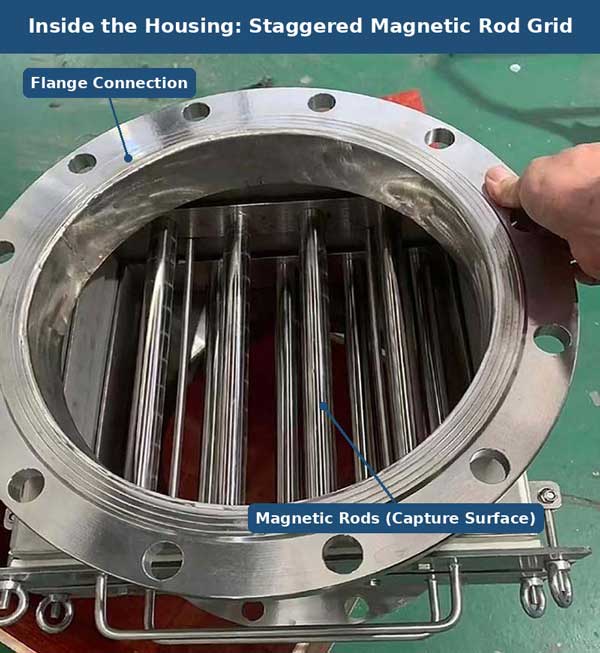
Unlike an in-line liquid trap or a round magnetic grate, a drawer separator is built around a rectangular housing welded (or bolted) into an existing hopper wall, chute, or duct section. Inside that housing sits a removable frame — the “drawer” — holding one or more tiers of parallel magnetic rods.
[Powder Inlet, gravity-fed]
|
v
+————————-+
| Housing (welded into |
| hopper wall / chute) |
| +———————+ |
| | = = = = = = = = = = | | <- Magnetic rod drawer
| | (slides out sideways)| |
| +———————+ |
+————————-+
|
v
[Purified Powder Outlet]
- Gravity Flow Through the Rod Grid: Powder enters through the upper inlet — round, square, or transitioned from standard pipe diameters such as DN100 through DN300 — and falls evenly through one or more tiers of magnetic rods spaced to force close, repeated contact between the material and the field.
- Capture on the Rod Surface: Ferrous fines, fine iron filings, and rust particles are drawn out of the falling stream and locked onto the rod surfaces on contact, while purified material continues through the gaps between rods and exits the lower discharge outlet.
- Drawer Withdrawal for Cleaning: When the operator needs to clean the unit, they release a latch or clamp on the outer housing and slide the entire rod assembly out horizontally as one piece. Because the rods come out together, there’s no need to access the inside of the hopper itself, and on many configurations the line doesn’t need to stop at all.
For applications with heavier contamination loads, the housing can hold more than one tier of rods — a second or third staggered layer set below the first — so material that slips past the top row still crosses at least one more magnetic field before reaching the outlet. The core difference from a round or square magnetic grate is orientation of maintenance access: a grate is typically opened from above or below the flow path, while a drawer is designed to be pulled out from the side of the housing — which matters enormously when a hopper is mounted low to the floor or wedged between other equipment with no vertical clearance.
Drawer-Type vs. Plate-Type vs. Grate: Choosing the Right Structure
All three designs use the same rare-earth magnetic core technology, but they suit different hopper geometries and powder behaviors.
| Structure | Best For | Access Direction | Typical Limitation |
| Drawer-Type Separator | Hoppers/chutes with side clearance but no room above or below | Horizontal (side pull-out) | Housing width limited by drawer slide length |
| Plate-Type Separator | Bulk conveyor discharge points, larger cross-sections | Top-mounted, hinged or lift-out plate | Less effective on very fine, low-velocity powders |
| Round/Square Grate | Circular hoppers, vertical pipe sections | Removed axially (up or down) | Needs vertical clearance above or below the unit |
For fine, cohesive powders — think micronized minerals, milk powder, or fine pigment — the drawer format has a practical edge: because the frame lifts out as a single sealed unit, there’s minimal opportunity for product to spill out of the housing mid-cleaning, which matters both for hygiene audits and for simply not wasting material on the floor.
Materials: Sanitary vs. Industrial Builds
As with our other separator lines, the housing and rod sleeve material should match the contamination risk profile of the powder being processed, not just its abrasiveness.
Sanitary Drawer Separators
Used for flour, dairy powder, infant formula bases, spice blends, and pharmaceutical excipients.
- Housing and rods in SUS316L stainless steel for resistance to cleaning acids and moisture exposure
- Continuous, ground-smooth welds with no exposed seams inside the powder contact zone
- Surface finish polished to Ra ≤ 0.8 µm, satisfying FDA and EHEDG hygienic design expectations
- Gasket and seal materials rated food-safe (silicone or FDA-grade EPDM)
Industrial Drawer Separators
Used for plastic resin, ceramic glaze powder, minerals, lithium battery materials, and recycled feedstock.
- Standard SUS304 stainless steel housing, sufficient for non-corrosive dry powders
- Grit-blasted or mill finish, generally in the Ra 2–3 µm range
- Optional polyurethane (PU) lining inside the housing wall for highly abrasive materials such as quartz sand or mineral powder — this protects the housing itself from wear, not just the rods, and meaningfully extends service life on gritty feedstock
- Reinforced drawer slides for abrasive or heavier bulk density materials (e.g., mineral fines, glass cullet)
Features & Technical Specifications
| Feature | Specification / Options |
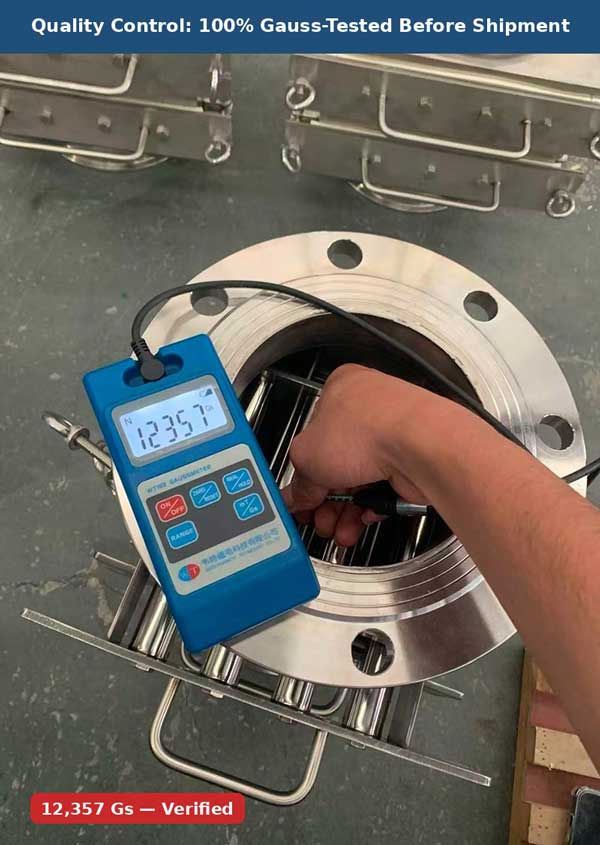
| Surface Gauss Rating | 8,000–15,000 Gauss, depending on rod grade and layer configuration |
| Rod Configuration | Single-layer, double-layer, or triple-layer staggered rod assemblies — additional layers trade a small pressure drop for meaningfully higher capture on fine ferrous fines |
| Housing Geometry | Square or rectangular outer housing; round, square, or standard pipe-diameter inlet/outlet transitions |
| Connection Options | Round or square flanges, tri-clamps, or direct pipe-diameter adapters to match existing ductwork |
| Operating Temperature | Standard builds to 80°C; high-temperature rod cores available up to 350°C, suitable for mounting directly beneath hot-air dryers or plastic extrusion lines |
| Housing Lining | Optional PU (polyurethane) lining for abrasive powders |
| Expected Service Life | Rated for a standard 10-year magnetic lifecycle with negligible field decay under normal operating conditions |
Because the housing is almost always custom-built to match an existing hopper or chute opening rather than sold off a shelf, sizing follows standard pipe-diameter series rather than one universal model. The table below shows a representative range across common inlet sizes:
| Series | Inlet Diameter (mm) | Housing Dimensions (mm) | Single-Layer Height (mm) | Rods per Layer (1/2/3 layers) |
| DN100 | 108 | 180 × 180 | 230 | 3 / 2+3 / 3+2+3 |
| DN125 | 133 | 200 × 200 | 230 | 3 / 2+3 / 3+2+3 |
| DN150 | 159 | 240 × 240 | 230 | 4 / 3+4 / 4+3+4 |
| DN200 | 219 | 280 × 280 | 260 | 5 / 4+5 / 5+4+5 |
| DN250 | 273 | 320 × 320 | 260 | 5 / 4+5 / 5+4+5 |
| DN300 | 325 | 400 × 400 | 320 | 6 / 5+6 / 6+5+6 |
Housing dimensions above are based on round-flange configurations; overall height increases with each additional rod layer, and rod counts can be adjusted further for application-specific throughput requirements.
The layer count deserves special attention during specification, in the same way rod spacing does on other separator types. A single layer is usually sufficient for powders with low-to-moderate metal risk and good flowability. Cohesive, fine, or high-contamination powders — recycled plastic regrind is a common example — benefit from a double or triple staggered layer, because material that slips past the first row of rods still crosses at least one more field before reaching the outlet. This is why a documented flow rate and a sample of the actual powder — not just a generic material name — should always accompany a drawer separator inquiry.
Cleaning and Maintenance: What Makes the Drawer Design Worth the Retrofit
The entire value proposition of a drawer-type unit over a fixed grate is maintenance speed. A typical cleaning cycle looks like this:
- Isolate the hopper feed (if the line allows a brief pause) or simply proceed if flow can continue safely with the drawer partially withdrawn.
- Release the latch or bolted clamp securing the drawer to the housing.
- Slide the rod assembly out horizontally along its guide rails.
- Wipe or brush the captured ferrous material off each rod — captured iron sits on the surface, so it’s fully exposed once the drawer is out.
- Reinsert and re-latch the drawer, restoring the magnetic field to the flow path in a couple of minutes for most single-layer configurations.
For high-contamination lines — recycled plastic regrind is a common example — the rods can be specified with optional quick-clean protective extractor sleeves. Rather than wiping each rod by hand, the operator slides the rod out of its sleeve, and the captured iron drops off instantly because the magnetic force no longer holds it against the (now empty) sleeve surface. This adds cost to the base unit but is worth evaluating for any hopper needing cleaning more than once per shift. Combined with a permanent-magnet core that holds field strength over roughly a ten-year service life, the recurring cost of ownership on a drawer separator is close to zero once it’s correctly specified.
How to Choose the Right Drawer Separator Part Number
Three questions determine nearly every specification decision for a drawer unit:
- What are the exact internal dimensions of your existing hopper wall or chute opening, and how much side clearance exists for drawer withdrawal?
Why it matters: Retrofitting into an existing structure means the housing footprint is fixed by what’s already there — but the drawer needs at least its own rod length in clear horizontal space to be pulled out. This is the detail most often missed in a first-pass inquiry.
- What is the bulk density, particle size, and flow characteristic of the powder — free-flowing, cohesive, or prone to bridging?
Why it matters: This determines whether a single-layer or a staggered double/triple-layer rod assembly is appropriate, and whether an abrasive powder justifies the added cost of a PU-lined housing. A powder that bridges easily may need a lower-restriction single layer even at some cost to capture efficiency, because a stalled hopper is a bigger production problem than a small percentage of missed fines.
- Does the application involve combustible dust, and is an ATEX or equivalent explosion-proof housing rating required?
Why it matters: Fine organic powders (starches, some pigments, certain plastic additives) can fall under combustible dust regulations, which affects both the housing design and the grounding/bonding requirements for the drawer assembly.
Where Drawer-Type Separators Are Used
Because the housing, connection type, and layer count can all be adapted to an existing pipe or hopper opening, drawer separators show up across a wider range of industries than their simple appearance suggests: food and beverage powder lines (flour, starch, spice blends), pharmaceutical excipient handling, lithium battery cathode and anode material production, plastics and polymer regrind, ceramic glaze and pigment powders, mining and building materials, and general recycling streams. The common thread across all of them isn’t the material itself — it’s a gravity-fed powder stream passing through a fixed point where a side-access, no-shutdown cleaning cycle is more valuable than the flow-through simplicity of a top- or bottom-accessed grate.
Partner with MagnetGlobal for Custom Hopper Protection
A drawer-type magnetic separator only performs as designed when its housing, layer configuration, and Gauss rating are matched to the exact hopper geometry and powder behavior it’s protecting — generic, off-the-shelf sizing is one of the most common causes of underperforming iron removal in gravity-fed lines.
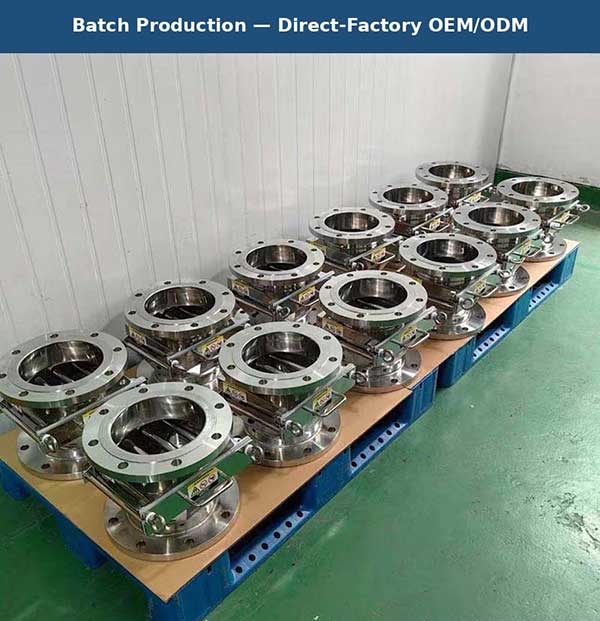
Contact MagnetGlobal’s engineering team with your hopper dimensions and powder specification for a custom drawer separator proposal, or browse our full range of magnetic separators to compare structural options. As a direct-factory OEM/ODM manufacturer, we build to your exact opening size rather than asking you to adapt your process to a standard catalog unit.