In modern B2B industrial manufacturing—whether processing food ingredients, fine chemicals, pharmaceuticals, or high-purity lithium battery materials—ferromagnetic contamination is a silent profit killer. Even microscopic iron particles can lead to catastrophic product defects, costly batch rejections, and severe wear on expensive downstream machinery.
To safeguard production lines, magnetic filter rods (also known as magnetic tubes or bars) serve as the ultimate frontline defense. However, global procurement managers and plant engineers often face a common dilemma: “With so many geometric profiles and structural designs available, which specific magnetic rod is right for my existing pipeline infrastructure and material characteristics?”
Selecting the wrong profile can lead to material clogging, excessive cleaning downtime, or untreated filtration “dead zones.” In this comprehensive buyer’s guide, we will break down the technical specifications, working principles, and ideal application scenarios for four distinct heavy-duty magnetic rod profiles manufactured by MagnetGlobal.
1. Quick Overview of the 4 Heavy-Duty Magnetic Rod Profiles
Before diving into the multi-dimensional comparison, let’s introduce the four foundational configurations engineered to intercept tramp iron in dry powders, bulk granular materials, and viscous liquid solutions.
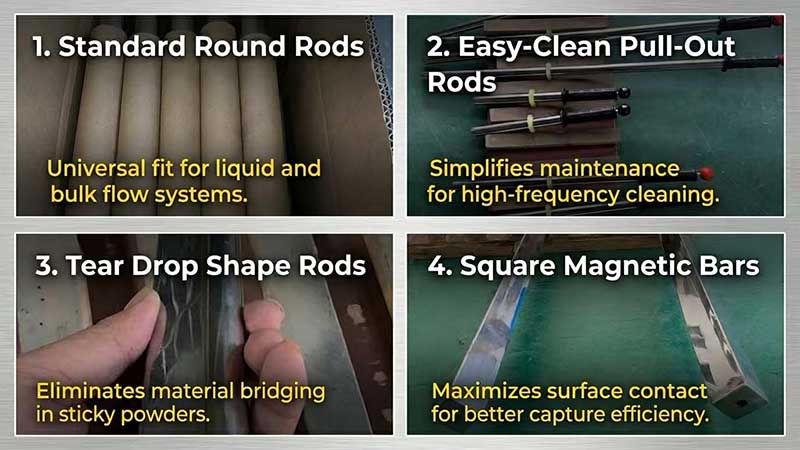
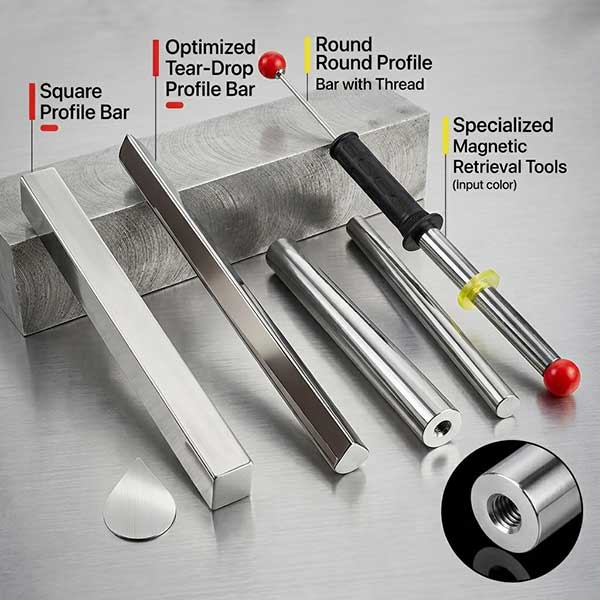
Profile A: Neodymium Magnetic Filter Rods (Standard Round)
The absolute technological cornerstone of modern industrial separation systems. Featuring a cylindrical cross-section encased in premium-grade, fully welded SUS304 or SUS316L stainless steel, these round bars utilize an intricate alternating stack of precision-machined neodymium (NdFeB) rare-earth permanent magnets and high-permeability flux-guiding plates. This classic design delivers the ultimate magnetic flux depth and a localized surface strength engineered up to a maximum of 15,000 Gauss.
Profile B: Easy-Clean Pull-Out Magnetic Rods (Quick-Clean Design)
Engineered specifically for rapid, manual iron removal without forcing operators into tedious manual scraping. This high-intensity filtration device features a dual-layer structure: an outer stainless steel protective sleeve and a retractable internal neodymium permanent magnetic core connected to a central pull rod and an ergonomic rubber handle. It enables seamless iron release in narrow or confined processing spaces.
Profile C: Tear Drop Shape Magnetic Rods (Anti-Bridging Profile)
A highly specialized aerodynamic profile designed to conquer the structural limitations of standard round bars when handling non-free-flowing materials. Enclosing a high-flux neodymium core within a pear-shaped or drop-shaped mirror-polished stainless steel shell (surface roughness Ra < 0.4μm), this design achieves up to 12,000 Gauss at its sharp apex—the exact point where material streams are split.
Profile D: Stainless Steel Square Magnetic Bars (Dead-Zone-Free)
Featuring a precise rectangular cross-section (19*19 mm up to 50*50 mm), this profile concentrates its massive magnetic pull across four flat planes rather than distributing it cylindrically. The flat geometry optimizes surface contact and is specifically tailored to fit flush against the straight inner walls of rectangular chutes, processing chambers, and square pipelines.
2. Core Comparison: Technical Parameters & Applications
To help your engineering team make a rapid, data-driven decision, here is a direct comparison of the technical limitations and commercial advantages of each MagnetGlobal profile:
| Magnetic Rod Type | Cross-Section Profile | Max Surface Gauss | Temperature Threshold | Key Commercial Advantage | Best Targeted Application |
| Standard Round Rods | Cylindrical (16–60 mm) | 6,000 – 15,000 G | Standard <= 80°C Custom up to 350°C | Most cost-effective; deepest magnetic field projection; vast customization. | Universal liquid lines, free-flowing gravity chutes, and granules. |
| Easy-Clean Pull-Out | Round Outer Sleeve | High-Strength Core | Standard <= 80°C | Zero-scraping manual release; drastically cuts downtime. | High-frequency cleaning lines, fine chemical powders, slurries. |
| Tear Drop Shape | Aerodynamic Pear-Shape | Up to 12,000 G (Apex) | Standard <= 80°CCustom up to 150°C | Eliminates material bridging; 100% active field exposure. | Cohesive/sticky powders (Milk powder, flour, sugar, fine pigments). |
| Square Magnetic Rods | Flat Planes | 6,000 – 14,000 G | Standard <= 80°C | Zero filtration dead zones; secure retention on flat faces. | Lithium battery coating lines, square chutes, tight spaces. |
3. Deep Dive: Which One Fits Your Specific Manufacturing Challenges?
To maximize separation efficiency, you must select your magnetic rod profile based on your specific material flow characteristics and automated plant design. Let’s look at three common operational scenarios:
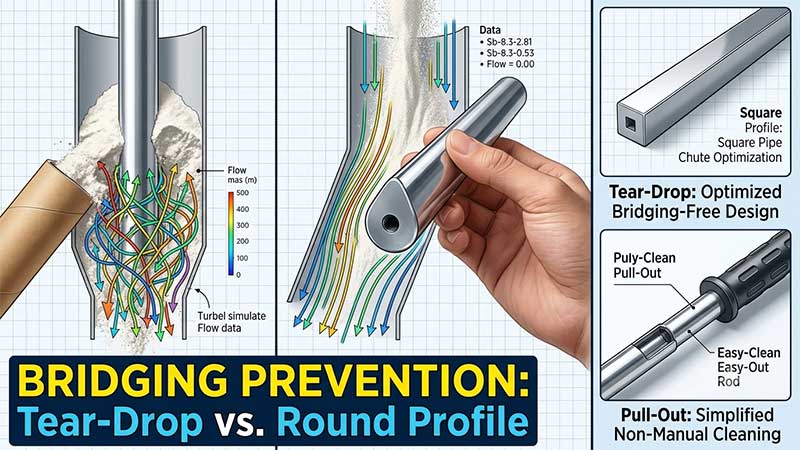
Scenario A: Handling Cohesive or Sticky Powders? Deploy the Tear Drop Shape
Standard cylindrical bars introduce a flat horizontal ridge on their top radius where fine, sticky, or damp bulk solids tend to accumulate. This accumulation rapidly triggers “bridging” or “caking,” which chokes gravity-fed hoppers and stalls production.
The Tear Drop Solution: The streamlined, sharp top radius of the Tear Drop profile smoothly splits the incoming product stream. The tapered sides guide the powder directly through the highest-intensity magnetic zones at the apex without stagnation. By keeping materials moving continuously, 100% of the stainless steel surface remains actively exposed to the material stream, yielding a significantly higher fine iron capture rate for difficult materials like flour, milk powder, starch, cocoa, and fine chemical pigments.
Scenario B: High Contamination Levels & Frequent Maintenance? Choose Easy-Clean Pull-Out
Manually wiping fine iron dust and sharp tramp metal off a standard 12,000 Gauss round rod requires physical effort and introduces safety hazards for plant workers. If your raw materials contain high iron levels that require cleaning multiple times per shift, production downtime will spike.
The Pull-Out Solution:
The self-cleaning action of the Easy-Clean Pull-Out rod completely eliminates manual wiping or scraping. When the accumulated ferrous contaminants need to be discharged, the operator simply pulls the ergonomic rubber handle. This simple action retracts the internal rare-earth magnetic core into the housing, instantly removing the magnetic field from the active outer tube surface. The trapped impurities automatically detach and drop into a collection bin. This mechanism ensures maximum worker safety and slashes routine maintenance downtime to mere seconds.
Scenario C: Square Chutes & Precision Battery Slurries? Install Square Magnetic Bars
When round magnetic rods are installed side-by-side inside a square pipeline or rectangular gravity chute, their curved surfaces naturally leave open, triangular gaps against the straight inner walls of the housing. This creates filtration “dead zones” where fast-moving raw materials can bypass the magnetic field entirely.
The Square Solution:
The flat surfaces of Square Magnetic Bars fit perfectly flush against straight equipment boundaries, ensuring that no raw material escapes filtration. Furthermore, the four flat planes provide a highly stable, low-velocity landing zone for captured micron-scale contaminants. Once trapped along the flat edges, the iron particles are securely locked away from the rushing material flow, completely preventing them from being washed back into the clean product stream. This makes them the premium choice for battery coating lines, ceramic glazing, and automated processing chambers.
4. Flexible Integration and Installation Methods
No matter which geometric profile you select, MagnetGlobal configurations are engineered for seamless physical mounting into your existing plant infrastructure. Depending on your material flow, you can utilize four versatile setups:
- Embedded Installation: Positioning individual bars horizontally within gravity-fed hoppers or vertical material pipelines. Highly suitable for general powders and granules.
- Suspended Installation: Suspending heavy-duty permanent tubes securely above conveyor belts or open discharge points to attract tramp iron upward from thick bulk material flows.
- Drawer-Type Installation: Pre-assembling multiple tiers of round, square, or easy-clean magnetic bars into modular, removable drawer grates. This is widely specified in automated, hygiene-sensitive food and pharmaceutical lines.
- Portable Operation: Utilizing individual lightweight rods manually for localized batch testing, container inspections, or mobile separation in temporary hoppers.
Conclusion: Partner with a Verified OEM Manufacturer
In the industrial sector, there is no single “perfect” magnetic rod shape—only the right engineering choice for your specific material characteristics and pipeline geometries.
As a premium international B2B brand backed by the comprehensive manufacturing power of Dongtai Yousheng Magnetic & Electric Co., Ltd., MagnetGlobal specializes in fully customizable permanent magnetic separation components. From standard round bars calibrated to 15,000 Gauss, to high-temperature models stabilized up to 350°C, to custom-engineered teardrop and square profiles, we precisely tailor diameters, lengths, and end-connection configurations (including internal threads, external studs, and eye bolts) to fit your precise blueprints.
Contact the engineering team at MagnetGlobal today to optimize your material purity, eliminate secondary contamination, and protect your downstream machinery with a low-operating-cost, passive physical separation system.
[Get The Best Price on Custom Industrial Magnetic Rods]